
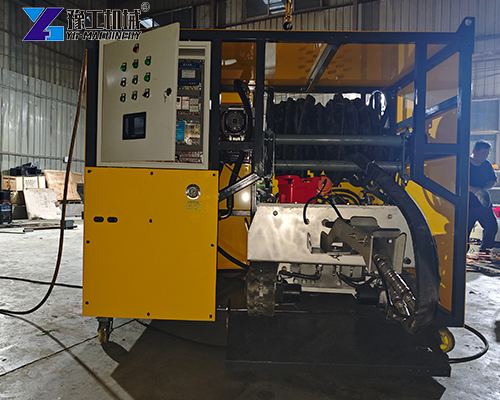
If the key words for the sludge cleaning industry in the past decade were “manual” and “high-risk,” then for the next decade, they will definitely be “robotic” and “intelligent.” From workers going down into tanks with shovels to remote-controlled robots performing precision cleaning, this technological shift is quietly reshaping municipal and industrial maintenance. As the core carrier of this transformation, the sludge cleaning machine integrates cutting-edge technologies such as underwater navigation, multi-sensor fusion, remote control, and explosion-proof protection, turning the ideal of “no sludge on the ground, no personnel in the tank” into reality.
Dedging Robot Parameters
| Model | YG500 Electric | YG600 Electric | YG700 Electric | YG800 Electric | YG900 Electric | YG1200 Electric |
| Robot Dimensions | 1500×500×650 mm | 1500×600×650 mm | 1600×700×650 mm | 1600×850×700 mm | 1650×960×750 mm | 1900×1200×750 mm |
| Slurry Pump Model | 3E-100Z170 | 3E-100Z170 | 4E-250ZJ45 | 4E-250ZJ45 | 4E-250ZJ45 | 4C-200Z125 |
| Cleaning Width | 500 mm | 600 mm | 700 mm | 800 mm | 900 mm | 1200 mm |
| Track Speed | 3–15 m/min | 3–15 m/min | 3–15 m/min | 3–15 m/min | 3–15 m/min | 3–15 m/min |
| Robot Weight | — | — | — | — | — | 500 kg |
| Pump Inlet Size | 3 inch | 3 inch | 4 inch | 4 inch | 4 inch | 5 inch |
| Pump Flow Rate | 100 m³/h | 100 m³/h | 160 m³/h | 160 m³/h | 200 m³/h | 200 m³/h |
| Pump Head | 0–30 m | 0–30 m | 0–25 m | 0–25 m | 0–25 m | 0–25 m |
| Hydraulic Station Dimensions | 2200×1200×1700 mm | 2200×1200×1700 mm | 2200×1200×1700 mm | 2200×1200×1700 mm | 2200×1200×1700 mm | 2120×1240×1200 mm |
| Main Motor Power | 18 kW | 18 kW | 22 kW | 22 kW | 22 kW | 45 kW |
| Hydraulic System Pressure | 0–16 MPa | 0–16 MPa | 0–16 MPa | 0–16 MPa | 0–16 MPa | 0–16 MPa |
| Max Particle Size | 15 mm | 15 mm | 40 mm | 40 mm | 50 mm | 60 mm |
| Winch Speed | 0–10 r/min | 0–10 r/min | 0–10 r/min | 0–10 r/min | 0–10 r/min | 0–10 r/min |
| Standard Hydraulic Hose Length | 50 m | 50 m | 50 m | 50 m | 50 m | 50 m |
| Control System | Wireless Remote Control | Wireless Remote Control | Wireless Remote Control | Wireless Remote Control | Wireless Remote Control | Wireless Remote Control |
| Lighting System | 2× Underwater LED Lights | 2× Underwater LED Lights | 2× Underwater LED Lights | 2× Underwater LED Lights | 2× Underwater LED Lights | 2× Underwater LED Lights |
Sludge Cleaning Machine Working Principle: Integrated Chopping, Cutting, Suction, and Conveying
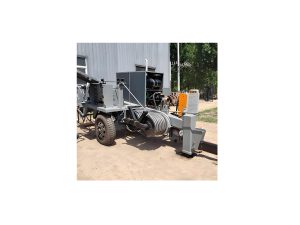
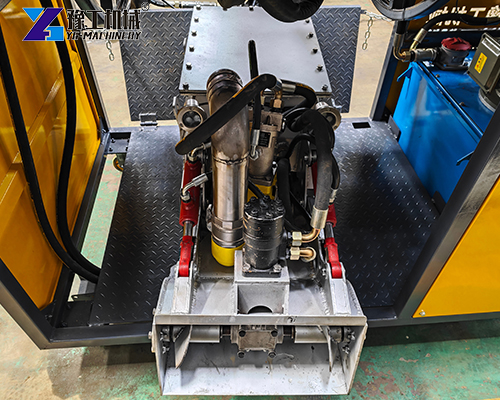
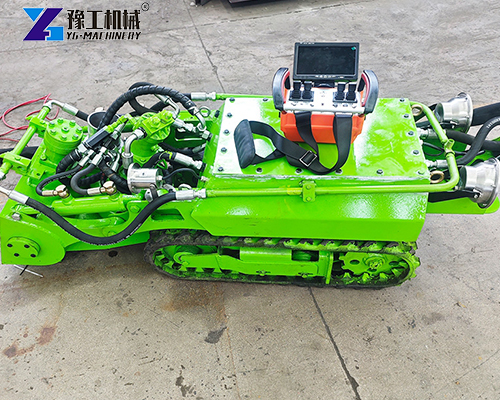
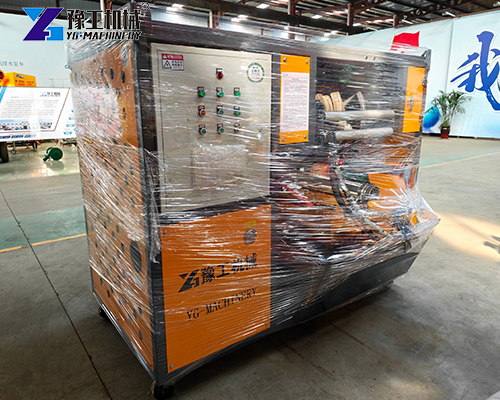
The sludge cleaning machine consists of four major parts: a hydraulic power unit, the robot body, oil hoses, and slurry discharge pipes. The hydraulic power unit serves as the system’s power heart, providing stable hydraulic drive for the robot’s movement, tool head rotation, and suction/pumping. As a fully functional dredging robot, its working process is highly integrated, with all components working together to form a complete chain from breaking to conveying.
The operator uses a wireless remote to guide the tracked chassis underwater. The robot automatically adjusts its travel posture according to the terrain of the tank or culvert bottom. The front end carries interchangeable tools such as a suction-chopping head, auger tiller, or crushing-chopping head, selected based on actual material conditions—for hard, compacted sludge with low moisture content, the auger tiller or crushing-chopping head is preferred for heavy cutting and breaking; for fluid slurry, the suction-chopping head is used for direct pickup and pumping.
After breaking, the slurry mixture is drawn into the pipeline via an extraction unit, which supports self-priming, pumping, pushing, or auger modes, switchable according to conveying distance, head requirements, and material characteristics. The drawn slurry is continuously sent through the discharge pipe to downstream treatment equipment, where it undergoes classification, separation, crushing, filtration, and other deep processing, ultimately achieving solid-liquid separation or waste reduction.
The entire process, from underwater breaking to surface discharge, is smooth and continuous, truly realizing the environmental goals of “system keeps running, personnel stays out of the tank, sludge stays off the ground.” This is not only the core advantage that distinguishes this dredging robot from traditional manual cleaning, but also a landmark breakthrough in both safety and efficiency for confined-space operations.
Tank Cleaning Robot System: Full System Architecture from Robot Body to Downstream Treatment
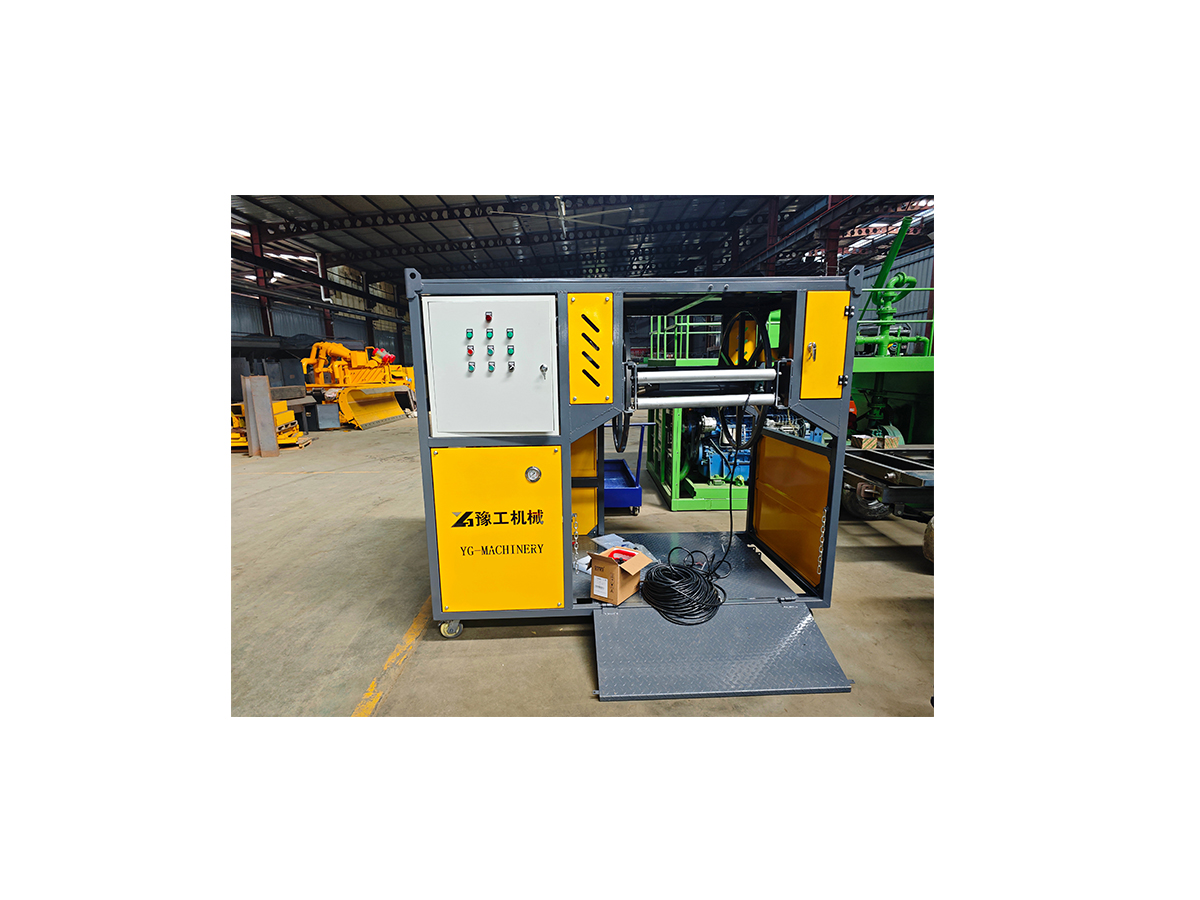
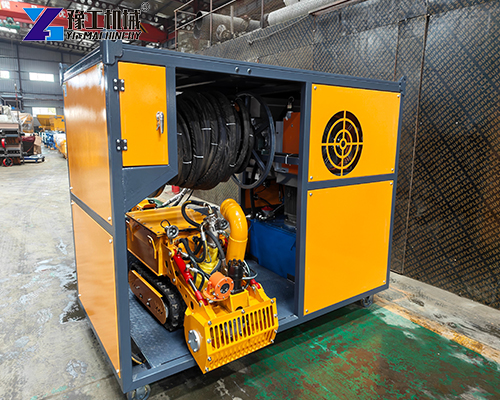
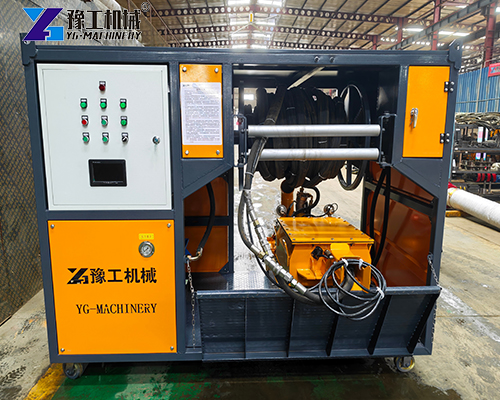
The tank cleaning robot system is not a standalone device, but a complete operating system composed of an underwater work unit, a surface power and control unit, material conveying pipelines, and a downstream treatment module. All units are linked through a unified remote control platform, allowing the operator to monitor and coordinate the entire process—from robot travel and breaking to sludge pumping—right from the surface control cabinet.
In terms of power, the system uses a centralized hydraulic power unit. The control cabinet integrates wireless remote, video signals, sensor data, and navigation information to ensure real-time coordination between the underwater robot and surface equipment. The tank cleaning robot system also supports explosion-proof configurations; both the power unit and control cabinet are explosion-protected, enabling safe operation in confined spaces with flammable gases or dust—this protection is built into the system design and does not rely on external modifications.
Unlike a single device, the system’s downstream treatment unit adopts a modular design, allowing flexible selection of solid-liquid separators, waste shredders, or filter presses based on material characteristics, enabling a “pump and process” continuous flow operation. The entire tank cleaning robot system’s hoses and cables are integrated on dedicated reels for easy deployment and retraction, avoiding messy on-site hose layouts and greatly reducing setup and relocation time. All system components are optimized and matched around the core chassis and pumping technology of the sludge cleaning machine, ensuring continuous operation for over 8 hours, with maintenance points concentrated on the surface unit for easy daily servicing.
How Does the Sludge Cleaning Machine Enable an Underwater “God’s Eye View”?
In turbid, zero-visibility underwater environments, how does an underwater dredging robot achieve precision work? This relies entirely on two core technologies: multi-sensor fusion navigation and real-time visual monitoring. The robot is equipped with LiDAR, high-sensitivity visual cameras, and multiple ultrasonic sensors, all working together: LiDAR scans the underwater terrain contours and obstacle distribution to build a 3D point-cloud map of the work area; ultrasonic sensors detect sudden obstacles in close range for millisecond-level collision avoidance; and visual cameras capture real-time underwater footage, using image enhancement algorithms to restore clear images under low-light and high-turbidity conditions.
All sensor data is fused at the control cabinet and transmitted back to the surface console through a single composite cable. The operator’s screen not only shows high-definition underwater video but also displays the robot’s real-time coordinates, travel path, tilt angles, and operating parameters of each tool head. This system gives the operator what feels like a “God’s eye view” through murky water, enabling precise guidance of the robot to every sediment deposit, ensuring accurate breaking and suction.
Additionally, the console offers assisted functions such as one-key return, fixed-point stop, and path planning, further lowering the skill threshold. Even first-time technicians, after brief training, can skillfully operate the underwater dredging robot to complete complex underwater cleaning tasks. This navigation and visualization system is the core technological barrier that distinguishes it from traditional blind cleaning and the fundamental guarantee for efficient and precise operation.
Sludge Cleaning Machine vs. Manual Cleaning: ROI Comparison
Traditional manual cleaning, sludge cleaning machine, and robotic cleaning differ significantly across multiple dimensions:
- Operation method: Traditional methods require personnel to enter tanks or wells, and systems must be shut down and drained; robotic cleaning is fully remote-controlled, allowing the system to stay operational.
- Safety risks: Manual cleaning faces high-frequency accidents like hydrogen sulfide poisoning, drowning, and collapses; robotic cleaning eliminates personnel entry, reducing safety risks to nearly zero.
- Per-shift efficiency: Manual crews can only clean dozens of cubic meters per shift; one robotic unit can handle 180–200 m³ per shift, increasing efficiency several times over.
- Total cost: Including labor, production loss, insurance, and potential accident compensation, the total cost of robotic cleaning is about 70% lower than manual cleaning.
Contact YG
Our company’s underwater dredging robot has been widely used in municipal drainage pipe maintenance, river ecological dredging, chemical pipeline cleaning, and sedimentation tank cleaning at wastewater treatment plants. Products are available in electric and diesel-powered versions, with an IP68 waterproof design ensuring stable operation at depths up to 30 meters. Whether you face narrow inspection wells, hazardous chemical storage tanks, or wide rivers and lakes, we can provide a tailored sludge cleaning machine solution. For more product details or to request a customized cleaning plan, please feel free to contact the YG team!