
When undertaking agricultural irrigation, rural water supply, industrial water usage, geothermal exploration, mine drainage, and emergency water intake projects, selecting a stable, efficient water well rig that adapts to complex formations directly affects well completion efficiency, drilling quality, and overall construction costs. For contractors who need to drill in sand, clay, gravel layers, weathered rock, and even hard rock formations, tracked hydraulic water well drilling rigs have become one of the mainstream construction machines.
Our water well rig series covers models including YG-180, YG-200, YG-300, YG-300A, YG-400, and YG-600. The drilling depth ranges from 180 m to 600 m, and the maximum drilling diameter reaches up to 350 mm. Whether you are looking for a compact rig for farm and village water supply projects, or deep well drilling equipment for deep water wells, industrial wells, and hard rock formation construction, you may select the proper model according to well depth, hole diameter, geological conditions, and air compressor configuration.
Parameters of Water Well Drilling Machine for Sale
| Model | YG-180 | YG–200 | YG–300 | YG–300A | YG–400 | YG–600 |
| Drilling hole diameter | 140- 254 mm | 140- 305 mm | 140-325 mm | 140-325 mm | 140-350 mm | 140-350 mm |
| Drilling depth | 180m | 200m | 300m | 300m | 400m | 600m |
| One-time advance length | 3.4m | 3.4m | 6.6m | 3.4m | 6.6m | 6.6m |
| Walking speed | 2.5km/h | 2.5km/h | 2.5km/h | 2.5km/h | 2.5km/h | 2.5km/h |
| Climbing angles (Max.) | 30 | 30 | 30 | 30 | 30 | 30 |
| Equipped capacitor | 55kw | 65-70kw | 84kw | 75.8kw | 92kw | 115kw |
| Using air pressure | 1.7-2.5mpa | 1.7-3.0mpa | 1.7-3.3mpa | 1.7-3.0mpa | 1.7-3.5mpa | 1.7-3.5mpa |
| Air consumption | 17-31m³/min | 17-30m³/min | 17-35m³/min | 17-35m³/min | 17-35m³/min | 17-35m³/min |
| Drill pipe length | 1.5m, 2.0m, 3.0m | 1.5m, 2.0m, 3.0m | 1.5m, 2.0m, 3.0m,6.0m | 1.5m, 2.0m, 3.0m | 1.5m, 2.0m, 3.0m,6.0m | 1.5m, 2.0m, 3.0m,6.0m |
| Drill pipe diameter | 76mm, 89mm | 76mm, 89mm | 89mm, 102mm | 76mm, 89mm, 102mm | 89mm,102mm,108mm | 102mm,108mm,114mm |
| Rig lifting force | 15t | 12t | 20t | 16t | 22t | 28t |
| Swing speed | 45-65rpm | 45-70rpm | 45–115rpm | 40–70rpm | 45-115rpm | 45–115rpm |
| Swing torque | 3200-4600(N.m) | 3500-4800(N.m) | 6200-8500(N.m) | 5700-7500(N.m) | 6500-9000(N.m) | 8500-11000(N.m) |
| Dimension | 3800*1500*2200mm | 4000*1750*2450mm | 5900*2000*2850mm | 4100*1950*2600mm | 5900*2100*2850mm | 6000*2200*2850mm |
| Weight | 4500kg | 5800kg | 9000kg | 7000kg | 10000kg | 12000kg |
What is a Water Well Rig?
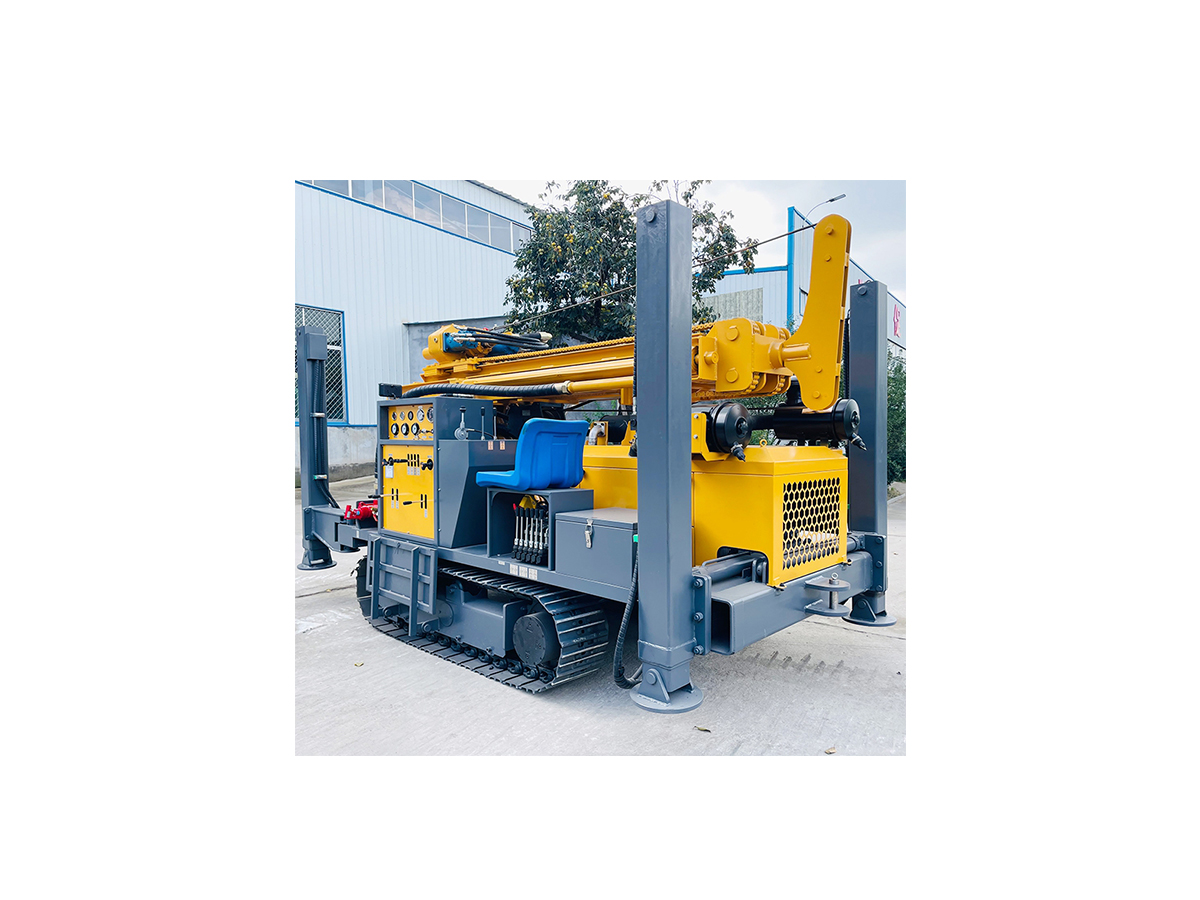
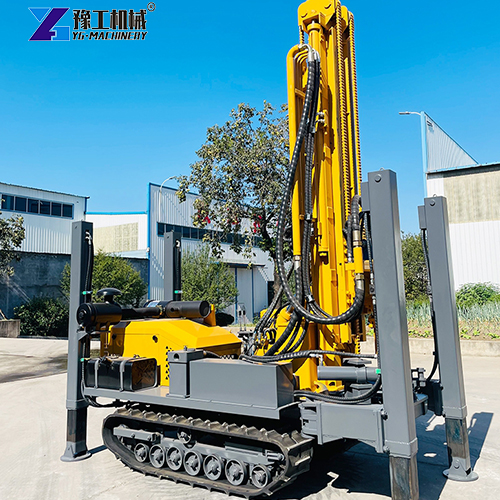
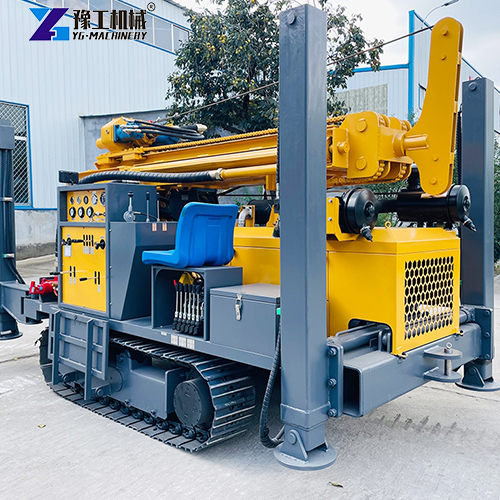
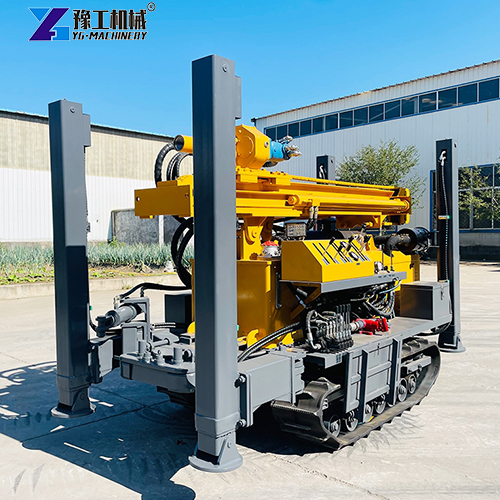
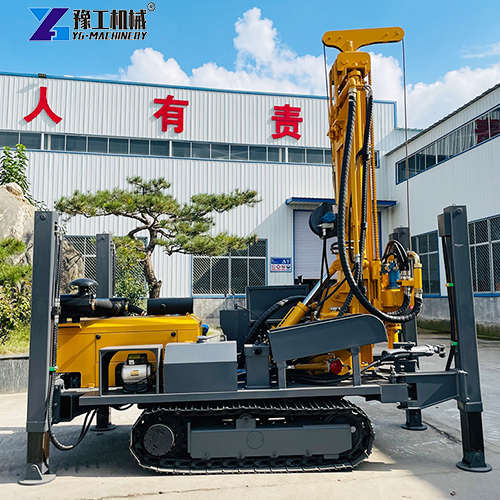
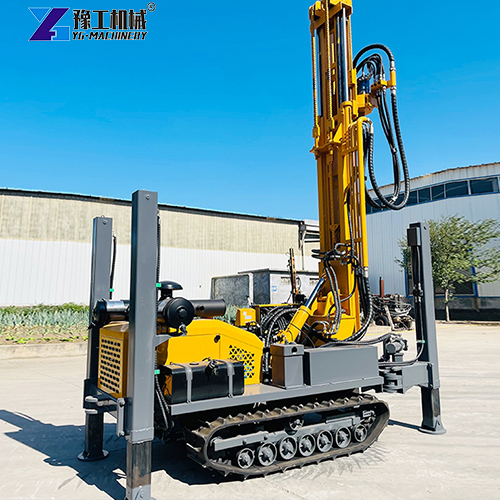
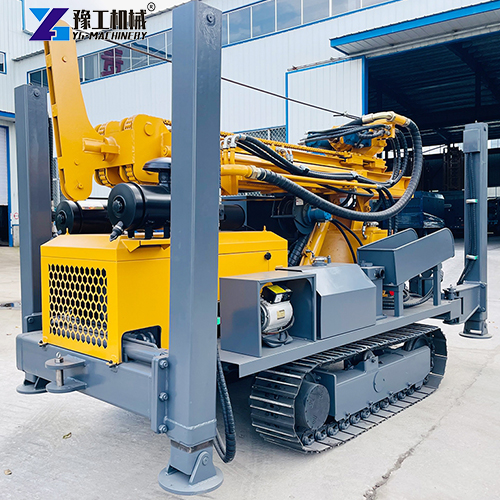
A water well rig is professional equipment for drilling groundwater wells, geothermal wells, dewatering wells, monitoring wells, and engineering investigation boreholes. It is generally integrated with a power system, hydraulic system, feed system, rotary power head, mast, winch unit, tracked chassis, and automatic hydraulic outriggers. It breaks formations and forms boreholes via rotary drilling, percussive drilling, and air flushing for cuttings removal.
Compared with traditional manual well digging and ordinary drilling equipment, modern tracked water well digging equipment has the following advantages:
- Wide formation adaptability, available for soil layers, sand layers, pebble layers, weathered rock, and hard rock formations.
- Tracked traveling structure delivers excellent site mobility, suitable for construction in mountainous areas, farmland, construction sites, and remote regions.
- Compatible with air compressors and DTH hammers for hard rock drilling to improve rock breaking efficiency.
- Hydraulic feed and hydraulic outriggers enable more stable operation and cut down manual adjustment time.
- Supports drill pipes of different diameters and lengths to meet varied well depth and bore size requirements.
- Applicable to multiple projects such as drinking water wells, irrigation wells, aquaculture water wells, geothermal wells, and industrial deep wells.
For buyers searching for a water well drilling machine for sale, equipment parameters are not the only benchmark. What truly matters is whether the drilling rig matches local geology, delivers sufficient torque and lifting force, has compatible air compressor parameters, and has easy availability of spare parts for after-sales service.
Working Principle of Water Well Digging Equipment
Water well digging equipment usually adopts a combination of rotary drilling and DTH hammer percussive drilling. During operation, a diesel engine or matched power unit drives the hydraulic system; the hydraulic power head rotates the drill pipes and drill bit. Compressed air is delivered through drill pipes to the borehole bottom to drive the DTH hammer to strike the drill bit continuously and break rocks.
Rock cuttings generated during drilling are blown out to the ground along the annular space between drill pipes and the borehole wall under compressed air. As drilling depth increases, operators keep adding drill pipes until the designed well depth is reached. After borehole completion, follow-up procedures including well casing installation, screen pipe fitting, gravel backfilling, well flushing, and pumping tests can be carried out.
How to Select a Suitable Water Well Drilling Machine for Sale?
When purchasing a water well drilling machine for sale, you should make your selection based on actual project conditions instead of only focusing on drilling depth or equipment price. Different water well rig models have obvious differences in torque, lifting force, air pressure requirements, drill pipe specifications, and transport convenience.
1. Select a model according to the designed well depth
If the project well depth is mainly within 100–180 meters, YG-180 is a cost-effective option for rural water supply, farmland irrigation, small breeding farms, and shallow groundwater exploitation.
For water well projects around 200 meters deep, YG-200 offers a wider range of drilling diameters and higher matched power, suitable for common civil and agricultural water well projects.
For target well depths of 250–300 meters, YG-300 or YG-300A has greater advantages. YG-300 features higher rotary speed, rotary torque of 6200–8500 N·m, and lifting force of 20 tons, ideal for projects with variable formations and high rock proportion.
For deep wells over 400 meters, industrial water supply wells, or geothermal-related projects, YG-400 or YG-600 is recommended. Especially YG-600, with maximum drilling depth up to 600 m, peak rotary torque of 11000 N·m, and lifting force of 28 tons, is more suitable for large-scale deep well projects and heavy-duty continuous construction.
2. Match torque and air compressor based on geological conditions
Geological conditions are one of the core factors in choosing water well digging equipment.
- In soft soil, sand, and clay layers, priority can be given to bore diameter, feed stability, and cuttings removal capacity.
- In gravel, pebble, and weathered rock layers, rotary torque, feed force, and air flushing efficiency need to be considered together.
- In hard rock formations such as granite, limestone, and basalt, the DTH hammer drilling process is recommended, equipped with high-pressure, large-displacement air compressors meeting equipment requirements.
- For deep-hole hard rock operations, high-torque models including YG-300, YG-400, or YG-600 are preferred.
For example, YG-600 requires working air pressure of 1.7–3.5 MPa and air consumption of 17–35 m³/min. During procurement, the air compressor shall cover the pressure and airflow range required by the rig. Insufficient air supply will reduce DTH hammer impact efficiency, cause poor cuttings discharge, or slow down drilling speed.
3. Pay attention to lifting force and drill pipe configuration
As borehole depth increases, the weight of the drill string and risk of drill sticking also rise. Therefore, lifting force is a non-negligible parameter for deep well construction.
- YG-180 lifting force: 15 tons, suitable for medium and shallow well construction.
- YG-300 lifting force: 20 tons, meets regular construction demands for 300-meter-level wells.
- YG-400 lifting force: 22 tons, applicable for deeper and larger-diameter operations.
- YG-600 lifting force: 28 tons, providing a larger safety margin for tripping drill pipes in deep wells and complex working conditions.
In terms of drill pipes, YG-300, YG-400, and YG-600 support 6 m drill pipes. Longer drill pipes reduce pipe connection times and improve deep well drilling efficiency. However, 1.5 m, 2 m, or 3 m drill pipes may be easier to manage when transport space is limited, working site is narrow, or operators lack sufficient equipment experience.
4 Advantages of YG Water Well Rig
YG series rigs are tracked hydraulic drilling machines that balance mobility, drilling capacity, and adaptability to complex job sites.
Tracked travel for complex construction sites
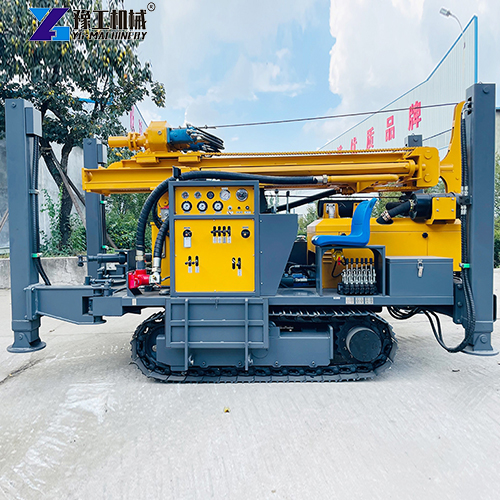
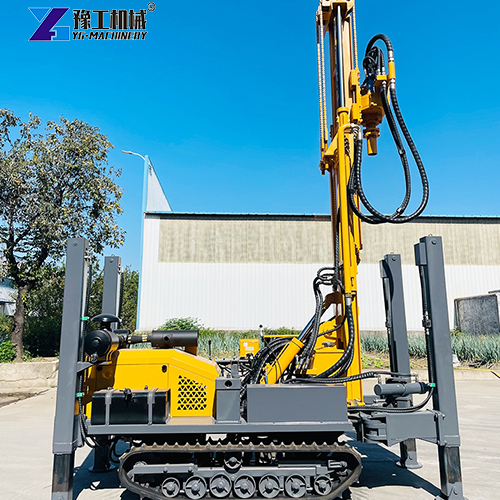
All models travel at 2.5 km/h with a maximum climbing capacity of 30°. The tracked structure improves equipment passability on muddy ground, gravel roads, farmland, mountain areas, and unpaved roads, cutting time costs from frequent hoisting or hauling.
High-torque power head for deep well and rock drilling
The rotary torque of the rig ranges from 3200–4600 N·m on YG-180 up to 8500–11000 N·m on YG-600. Higher torque means stronger performance in large-diameter drilling, deep-hole operation, complex rock strata, and high-resistance formations.
Automatic hydraulic outriggers for improved construction stability
The equipment is equipped with automatically extendable hydraulic outriggers. After the machine arrives at the working position, operators can extend/retract outriggers and level the machine body via hydraulic control. It improves overall stability during drilling and reduces time for manual leveling and support.
Customizable engine brands and configurations
Engines can be fitted with famous Chinese brands for different models, such as Changchai, Quanchai, Yuchai, or Cummins. Custom configurations are available if projects have specific requirements for engine brand, emission standard, power output, or local after-sales service.
Application Fields of Water Well Drilling Rigs
A professional water well drilling rig is not only used for conventional drinking water well construction, but also serves various underground engineering and water resource development projects:
- Agricultural irrigation wells: supply stable groundwater for farmland, orchards, greenhouses, pastures, and breeding bases.
- Rural & community water supply wells: for centralized village water supply, remote area water intake, and domestic water projects.
- Industrial water wells: meet water demands of factories, ore washing, building construction, cooling systems and production.
- Geothermal well construction: for pre-drilling of ground-source heat pumps and partial geothermal resource development.
- Dewatering & drainage wells: for underground works, foundation pit dewatering, mine drainage and construction water drainage.
- Investigation & monitoring boreholes: for groundwater monitoring, hydrogeological survey and engineering geological drilling.
Speak with Our Product Manager
FAQs about Water Well Rig
Q: Can this type of water well rig be used in hard rock formations?
Yes. For areas with hard rock, it is recommended to operate the water well drilling rig matched with an air compressor, DTH hammer, and rock drill bits. The DTH hammer delivers high-frequency impact force directly at the borehole bottom, suitable for granite, limestone, sandstone, and other hard rock formations. Specific configurations shall be determined according to rock hardness, well depth, bore diameter, and local altitude.
Q: What brand is the engine?
Engines can be Changchai, Quanchai, Yuchai, Cummins, and other brands, subject to rig model and configuration requirements. Buyers with specified engine brand demands can get customized solutions for projects.
Q: How many meters can a water well drilling rig drill per hour?
Under normal conditions, the drilling speed can reach approximately 30–40 meters per hour, but this value is not fixed. Actual efficiency is affected by geological hardness, rock fracture condition, bore diameter, well depth, air compressor airflow & pressure, drill bit wear, operator experience, and cuttings removal status.
For instance, drilling speed is usually higher in soft and stable formations, while in solid hard rock or fractured complex zones, penetration rate may drop significantly. In later-stage deep well construction, total footage will also be affected by pipe adding, tripping, and borehole cleaning.
Q: How long can a DTH hammer last?
With proper operation and regular maintenance, a DTH hammer can generally serve around 2–3 years. Its actual service life depends on compressed air cleanliness, lubrication condition, air pressure stability, formation abrasiveness, and daily maintenance quality. It is recommended to use qualified lubricating oil and drain water from air compressor tanks in a timely manner to reduce wear of internal components.
Q: What is the service life of drill bits?
Drill bit service life is closely related to geological conditions. Normally, a drill bit can be used for about half a year. However, wear will accelerate in highly abrasive sand-gravel layers, hard rock formations, or continuous heavy-duty construction. Inspect drill bit carbide buttons, air holes, outer diameter wear, and impact surface status regularly. Avoid continuous operation with severely worn bits, which will reduce drilling speed or affect bore diameter.
Q: Can hydraulic outriggers extend and retract automatically?
Yes. YG series water well drilling rigs adopt a hydraulic outrigger design for automatic extension and retraction, used for rig leveling and stable operation support. This design improves site setup efficiency and helps maintain borehole verticality and equipment working stability.
Contact YG
If you are looking for a water well drilling machine for sale with stable performance, hard rock formation adaptability, and customizable engine & drill pipe configurations, YG series tracked water well rigs can deliver efficient and reliable construction support for agricultural, industrial, water supply, geothermal, and engineering drilling projects.