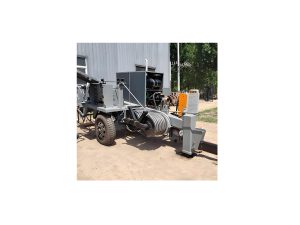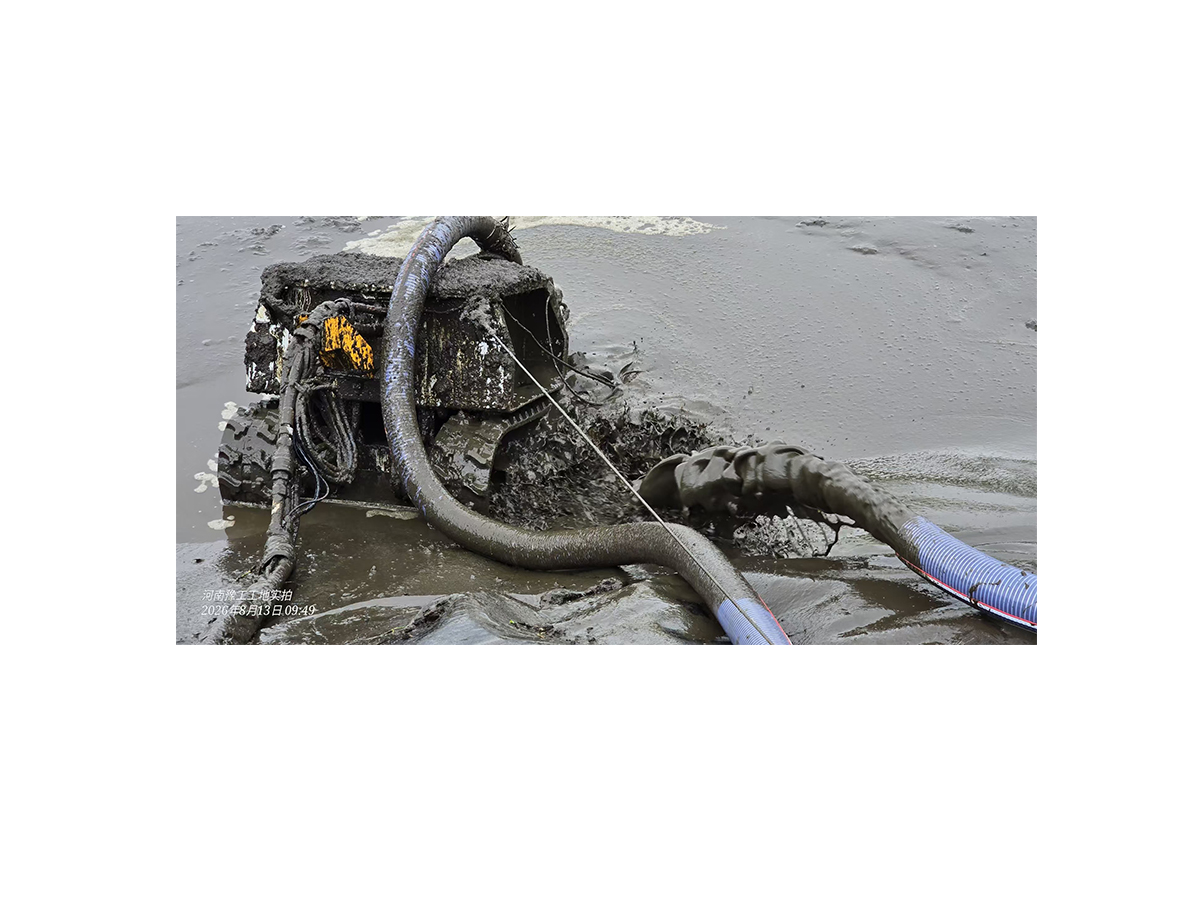

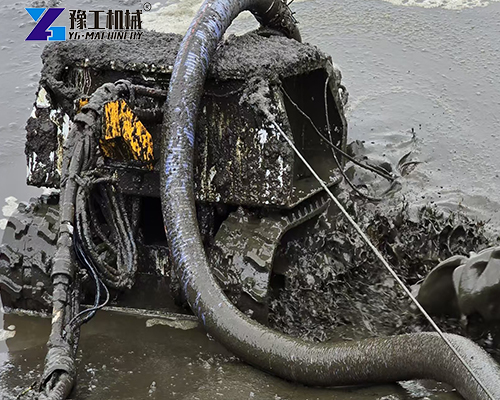
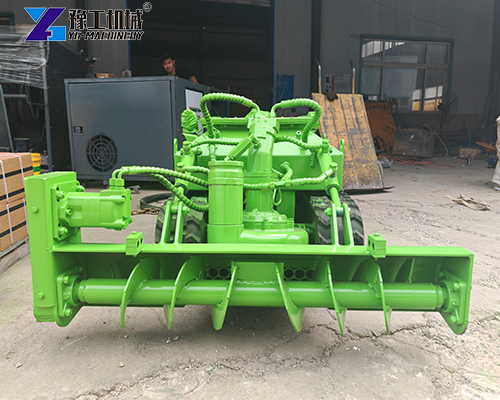
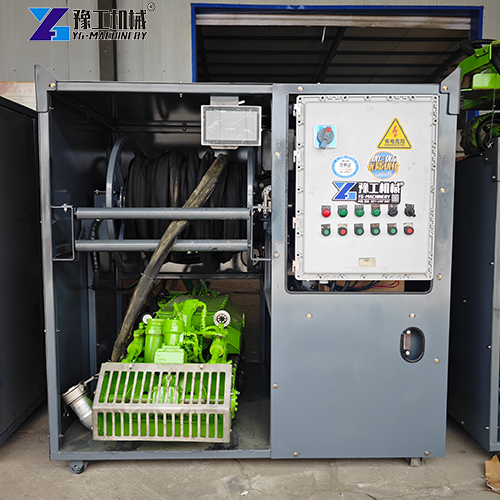
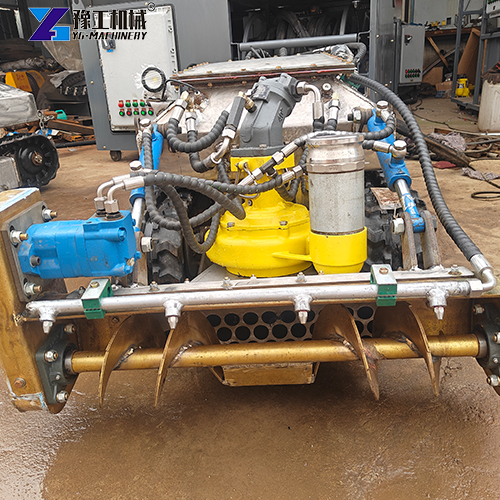
A dredging robot for sludge removal is essentially an underwater working system integrating travelling, agitating, crushing, suction, and conveying. It travels via a tracked chassis, agitates and breaks materials through the front-mounted auger or crushing structure, sucks sludge by a slurry pump, and transports media through sewage discharge pipes. All these coordinated operations are remotely controlled by one operator on the ground via a wireless remote controller. YG dredging robot full series is equipped with underwater LED lights and optional cameras. Operators can monitor underwater conditions in real-time on screen and control every movement precisely. This article gives an in-depth analysis of core technologies and selection tips for YG dredging robots.
YG Dredging Robot for Sludge Removal Specifications
| Model | YG500 Electric | YG600 Electric | YG700 Electric | YG800 Electric | YG900 Electric | YG1200 Electric |
| Robot Dimensions | 1500×500×650 mm | 1500×600×650 mm | 1600×700×650 mm | 1600×850×700 mm | 1650×960×750 mm | 1900×1200×750 mm |
| Slurry Pump Model | 3E-100Z170 | 3E-100Z170 | 4E-250ZJ45 | 4E-250ZJ45 | 4E-250ZJ45 | 4C-200Z125 |
| Cleaning Width | 500 mm | 600 mm | 700 mm | 800 mm | 900 mm | 1200 mm |
| Track Speed | 3–15 m/min | 3–15 m/min | 3–15 m/min | 3–15 m/min | 3–15 m/min | 3–15 m/min |
| Robot Weight | — | — | — | — | — | 500 kg |
| Pump Inlet Size | 3 inch | 3 inch | 4 inch | 4 inch | 4 inch | 5 inch |
| Pump Flow Rate | 100 m³/h | 100 m³/h | 160 m³/h | 160 m³/h | 200 m³/h | 200 m³/h |
| Pump Head | 0–30 m | 0–30 m | 0–25 m | 0–25 m | 0–25 m | 0–25 m |
| Hydraulic Station Dimensions | 2200×1200×1700 mm | 2200×1200×1700 mm | 2200×1200×1700 mm | 2200×1200×1700 mm | 2200×1200×1700 mm | 2120×1240×1200 mm |
| Main Motor Power | 18 kW | 18 kW | 22 kW | 22 kW | 22 kW | 45 kW |
| Hydraulic System Pressure | 0–16 MPa | 0–16 MPa | 0–16 MPa | 0–16 MPa | 0–16 MPa | 0–16 MPa |
| Max Particle Size | 15 mm | 15 mm | 40 mm | 40 mm | 50 mm | 60 mm |
| Winch Speed | 0–10 r/min | 0–10 r/min | 0–10 r/min | 0–10 r/min | 0–10 r/min | 0–10 r/min |
| Standard Hydraulic Hose Length | 50 m | 50 m | 50 m | 50 m | 50 m | 50 m |
| Control System | Wireless Remote Control | Wireless Remote Control | Wireless Remote Control | Wireless Remote Control | Wireless Remote Control | Wireless Remote Control |
| Lighting System | 2× Underwater LED Lights | 2× Underwater LED Lights | 2× Underwater LED Lights | 2× Underwater LED Lights | 2× Underwater LED Lights | 2× Underwater LED Lights |
Auger Vs Crushing Structure — How to Select the Front End for Sludge Cleaning Robot
The front end of a dredging robot is the core component that directly determines dredging efficiency. It agitates, cuts, and feeds sediments into the pump suction inlet. Front-end selection for a sludge cleaning robot must be based on the physical properties of sediments.
Auger Structure:
- Suitable for soft, high-moisture sludge such as sediment-tank deposits, river bottom silt, and food-industry residues
- The auger works like a conveyor, continuously gathering loose sludge toward the pump inlet and lowering clogging risks
- Ideal for working conditions with good slurry fluidity and low hardness
- Rotating auger completes agitating, mixing and collecting simultaneously
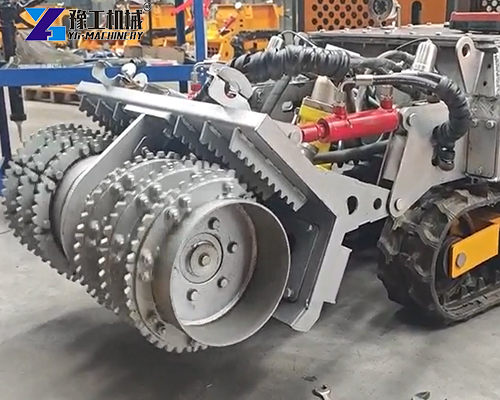
Crushing Structure:
- Designed for hardened, compacted, or debris-mixed sediments, e.g. scale buildup at the bottom of chemical storage tanks and sand-mixed deposits in urban pipe networks
- Effectively breaks massive hard scale and compacted sediment layers
- Inspect wear of crushing components every half-month under frequent-use conditions
Interchangeable Front Ends: This is one major advantage of the YG sludge cleaning machine. Users do not need to purchase two separate units. One single robot can quickly switch between auger head and crushing head on-site for multi-purpose operation according to actual working conditions.
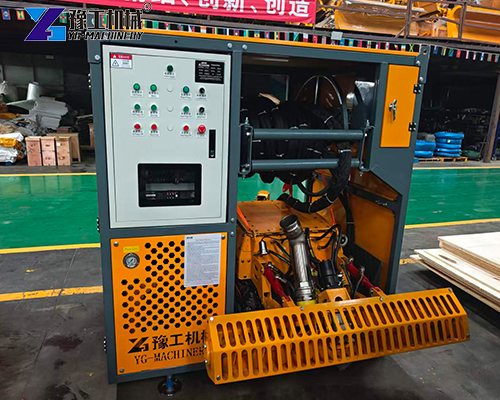
How to Choose Different Optional Configurations for the Sludge Cleaning Machine?
Optional systems of dredging robot for sludge removal allow precise configuration for specific project requirements:
| Optional Feature | Application Scenario | Description |
| Underwater Camera | Low-visibility storage tanks, deep wells, confined spaces | Real-time visual operation, precise navigation and obstacle avoidance |
| Electric Display (on control cabinet) | Indoor sites with stable fixed power supply | Centralized monitoring of all robot operating parameters |
| Diesel-powered Display (intermediate unit) | Outdoor sites or locations without grid power | Mobile monitoring, independent from fixed power source |
| High-pressure Flushing Pump | Compacted sludge, pipe-wall attachments | Pre-break hard sediment layers and improve front-end processing efficiency |
| Auger-to-Crushing-Head Conversion Kit | Multi-media projects, mixed-sediment conditions | One unit handles both soft sludge and hard scale |
| Full-unit Explosion-proof (control + motor/hydraulics) | Chemical plants, oil-gas sites, flammable-explosive environments | Guarantees operation safety in hazardous areas |
| Diesel-powered Hydraulic Station | Remote sites with unstable power supply | Independent power output, free from cable constraints |
| Extended Sewage Discharge Pipe | Long-distance slurry transportation | Extend conveying distance from robot to dewatering site |
| Upgraded Wireless Remote Control | Large-size tanks, long-distance safe operation | Improve operator flexibility and safety distance |
Selection Principle: Configure according to the worst-case working condition. Full-unit explosion-proof is mandatory if the unit frequently works in flammable/explosive environments. A diesel-powered hydraulic station is essential for sites with unstable power supply.
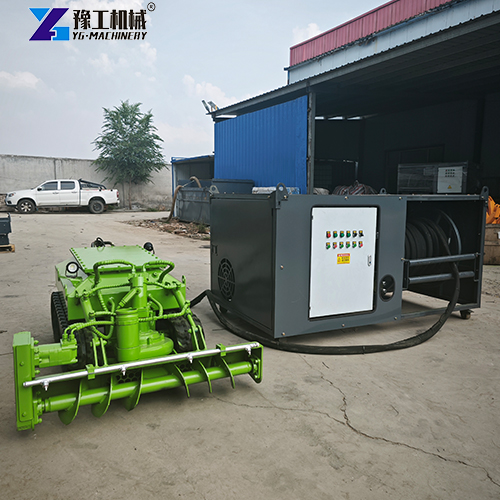
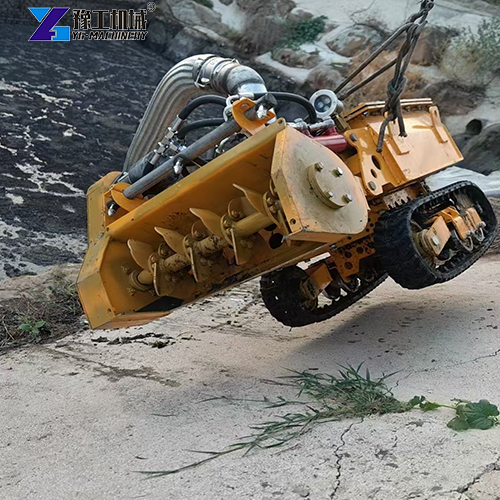
Performance of Crawler Dredging Robot on Different Tank-bottom Conditions
Tracked chassis is a key advantage of dredging robots over whee-type or floating alternatives. Below is the performance of the YG crawler dredging robot under typical tank-bottom conditions:
Soft-sludge Bottom (sedimentation tanks, oxidation ponds):
- Wide track contact area evenly distributes machine weight and effectively prevents sinking
- Stepless track speed from 3-15 m/min adapts to slurries of different concentrations
- Cooperates with auger front end to gather high-fluidity sludge efficiently
Hardened-scaling Bottom (industrial storage tanks, chemical vessels):
- Robust crushing head breaks crystalline sediment layers supported by steady track propulsion
- 0-16 MPa hydraulic-system pressure delivers sufficient thrust to penetrate compacted layers
- Track traction ensures stable positioning on uneven, semi-solid surfaces
Debris-mixed Bottom (municipal pipelines, pump stations):
- With sand, broken bricks, and plastic waste mixed in, the tracked chassis delivers stable traction on irregular surfaces
- Maximum passable particle size ranges from 15 mm (YG500) to 60 mm (YG1200) to fit various debris sizes
- Optional high-pressure flushing pump pre-loosens compacted mixed sediments
Sloped or Uneven Bottom:
- Low-center-of-gravity design and high-torque drive ensure stable operation on slopes up to 20°
- Independent track control enables fine heading adjustment without external traction equipment
Common On-Site Dredging Pain Points & Solutions
| Construction Pain Point | YG dredging robot for sludge removal Solution |
| Poisoning risk from toxic gas such as H₂S when personnel enter confined spaces | Fully remote unmanned operation; no personnel need to enter tanks |
| Compacted-hardened sediments cannot be extracted by conventional suction pumps | Powerful crushing head combined with high-pressure flushing pump for scale breaking |
| Frequent slurry-pump clogging and debris tangling | Max passable particle size up to 60 mm; auger front end pre-sorts materials |
| No power supply at remote construction sites | Diesel-powered hydraulic station provides independent power, no cable restrictions |
| Poor underwater visibility causing large blind operating zones | Underwater camera plus display for real-time monitoring |
| Long distance between dredging spot and dewatering yard | Extended discharge pipe plus pump head up to 30 m |
| Explosion-proof requirements for chemical-plant sites | Full-unit explosion-proof kit covering control system, motors and hydraulics |
| Multiple projects with varied sediment types | Interchangeable front ends (auger ↔ crushing); one unit adapts to diverse conditions |
Choose YG Dredging Robot for Sludge Removal
Looking for a proper dredging robot for sludge removal solution? YG supplies a full-range product lineup covering compact YG500 for municipal manholes up to heavy-duty YG1200 for large-scale industrial dredging. Interchangeable front ends, flexible power options (electric / diesel), and complete safety configurations, including explosion-proof kits, cameras, and high-pressure flushing, make our sludge cleaning machine capable of handling complex working conditions. Contact YG today for your custom-tailored dredging solution for your project.