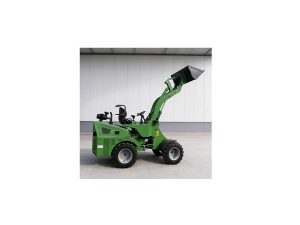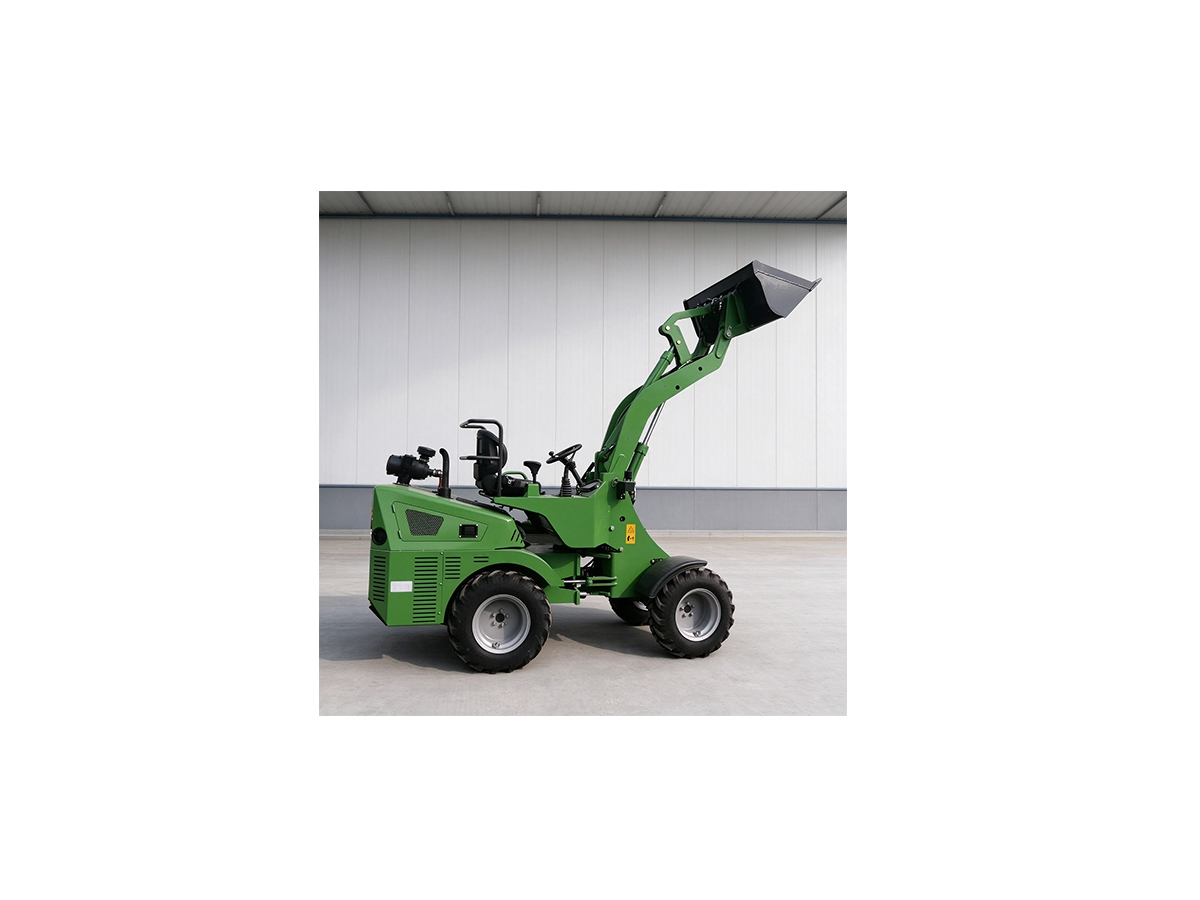

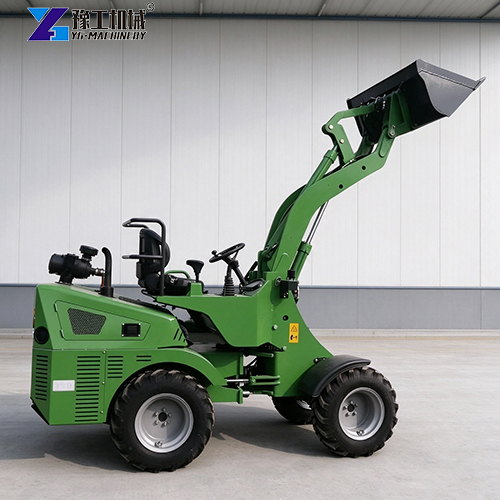
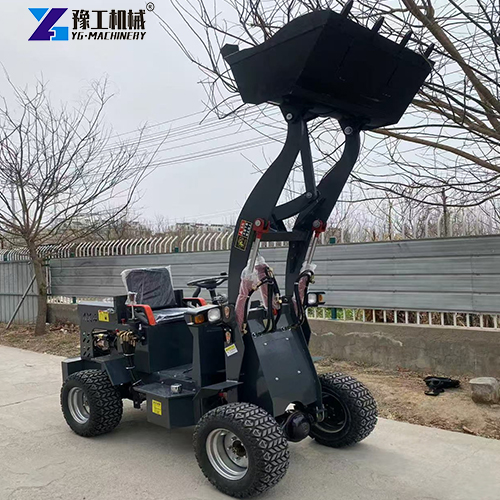
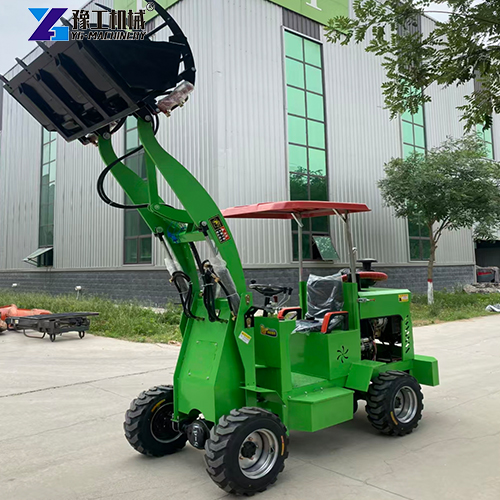
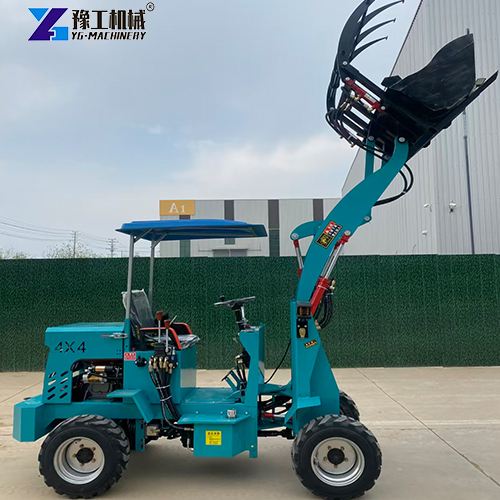
small front loader is a material handling machine suitable for small and medium contractors, farmers, landscaping companies, warehousing businesses, and municipal sanitation departments. It can carry out cleaning, shoveling, transporting, loading/unloading, and snow removal work. Compared with large wheel loaders, it is more compact and easy to operate on farm aisles, warehouses, landscaping sites, and small urban construction sites.
What Can YG Small Front Loader Do
This small front loader is designed mainly for daily material handling and light loading tasks. It is not built for large mines or massive earthworks. Instead, it fits users who need frequent material transport while working in confined sites.
Core Working Specifications
| Item | Specification |
| Max lifting height | 3 m |
| Max dumping height | 2.1 m |
| Bucket capacity | 1.2 m³ |
| Tire size | 23X8.5-12 |
| Overall machine width | 1.3 m |
| Overall machine height | 1.5 m |
| Overall machine length | 3.6 m |
The 3 m lifting height meets loading needs for small trucks, trailers, hoppers and low material piles. The 2.1 m dumping height works for regular loading and unloading at farms, landscaping sites, storage yards and small construction sites.
Typical application scenarios:
- Farm cleaning for manure, bedding and feed.
- Transporting soil, compost, wood chips and fertilizer.
- Bulk material loading and unloading in warehouses or stock yards.
- Moving bark, gravel and mulch in landscaping projects.
- Transferring sand, bricks and construction materials on small job sites.
- Snow removal on farm roads, parking lots and yards.
- Clearing snow, fallen leaves and light waste for municipal sanitation.
At 1.3 m wide, this machine can easily pass narrow aisles, farm gates, warehouse entrances and garden paths compared with larger equipment. The 23X8.5-12 tires fit most common working ground. Still, operators should select proper working methods based on material weight, ground conditions, and safe load limits.
Key Configurations for Practical Work
This compact front loader is fitted with a Changchai diesel engine, with two power options: 25 HP or 32 HP. Its transmission system uses a half-shaft axle and a nine-spring clutch. It has 3 forward gears + 1 reverse gear to meet basic travel and loading needs for farms, landscaping, warehouses, and small construction sites.
Main configurations:
- Changchai diesel engine.
- Half-shaft axle.
- Nine-spring clutch.
- 3 forward gears and 1 reverse gear.
- Single lever boom control.
- One-touch electric start.
- 4 mm thick bucket.
- 2 cm thick boom.
- Trailer hitch.
Single lever boom control simplifies loading movements, helping operators lift and dump materials easily. For farms, warehouses, and municipal teams with shift workers, simple and intuitive controls cut training difficulty.
The 4 mm bucket and 2 cm boom handle common bulk materials such as soil, sand, compost, feed, and snow. Compared with large construction wheel loaders, this model excels in size, maneuverability, and performance in narrow sites. But it cannot replace heavy-duty large machines for mining, heavy earthmoving, or continuous high-intensity construction.
25 HP vs 32 HP: How to Pick the Right Small Front Loader
The 25 HP version and 32 HP version share the same body dimensions, bucket capacity, lifting height, and major mechanical configurations. The main difference lies in engine power. Your choice should focus on daily working hours, material types, ground conditions, and operation intensity.
| Item | 25 HP Version | 32 HP Version |
| Engine | Changchai diesel engine, 25 HP | Changchai diesel engine, 32 HP |
| Lifting height | 3 m | 3 m |
| Dumping height | 2.1 m | 2.1 m |
| Bucket capacity | 1.2 m³ | 1.2 m³ |
| Tire | 23X8.5-12 | 23X8.5-12 |
| Axle | Half-shaft axle | Half-shaft axle |
| Clutch | Nine-spring clutch | Nine-spring clutch |
| Gear | 3 forward, 1 reverse | 3 forward, 1 reverse |
| Boom control | Single lever operation | Single lever operation |
| Starting system | One-touch electric start | One-touch electric start |
| Machine width | 1.3 m | 1.3 m |
| Machine height | 1.5 m | 1.5 m |
| Machine length | 3.6 m | 3.6 m |
| Trailer hitch | Yes | Yes |
| Bucket thickness | 4 mm | 4 mm |
| Boom thickness | 2 cm | 2 cm |
Who is the 25 HP version for
The 25 HP model suits users with medium workload and stable daily operation hours, such as farms, landscaping firms, warehouses, property maintenance teams, and small contractors.
If your main tasks include manure cleaning, feed transport, soil loading, wood chip handling, snow clearing, or moving light building materials, the 25 HP unit can handle basic needs. It also works as material handling and site cleaning equipment for occasional small construction projects.
Who is the 32 HP version for
The 32 HP version fits users with higher operation frequency, longer working hours, or tougher ground conditions. Small engineering contractors, municipal maintenance teams, and farms that run the machine all day can prefer this model with extra power reserve.
Since both models have identical bucket capacity, lifting height, and body size, the 32 HP version does NOT come with a bigger bucket or higher dumping height. Its main advantage is stronger power reserve, making it more suitable for sloped land, soft ground, or continuous loading and unloading work.
If you are selecting a compact front loader for small building projects, besides engine horsepower, you need to check rated load, machine weight, hydraulic parameters, and material density to avoid overloading.
Where to Buy Small Wheel Loader for Sale
Searching for a small wheel loader for sale is easy. But finding a reliable machine plus a supplier who truly takes responsibility for the equipment is not simple.
There are many online listings. Most only show prices without machine details. No engine brand, no parts list, no export experience, and no after-sales support. Many buyers get cheap machines this way, only to face breakdowns in the first month with no spare parts available.
When you look for a small wheel loader for sale, check these key points:
- Whether the supplier has stable export experience — familiar with packaging, documents, and sea freight to avoid issues when machines arrive at port
- Whether specifications are clear and true — engine brand, boom thickness, bucket thickness, clutch type, and overall machine dimensions
- Whether spare parts are available — long-term supply of filters, belts, fuel injectors, clutch parts, and hydraulic components
- Whether real photos and videos are provided — actual site shots instead of stock images
- Whether there are real customer references — ideally buyers from your region or industry
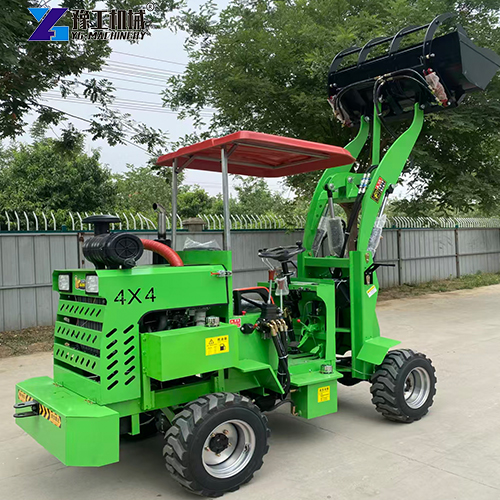
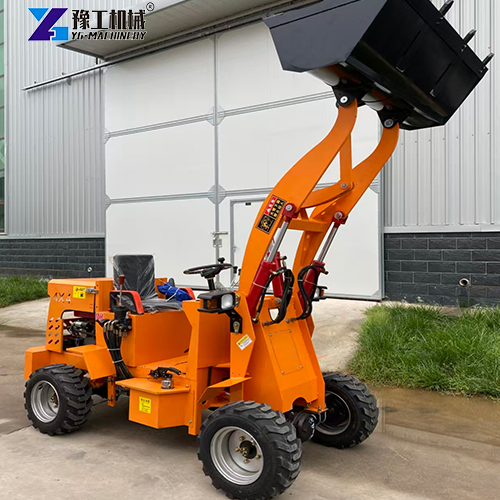
YG is a factory following these standards. Our 25 HP and 32 HP small construction wheel loaders are all manufactured in our own factory, equipped with a Changchai diesel engine, half-shaft axle, nine-spring clutch, and 2 cm boom. Every unit is assembled, tested, and inspected before shipment. Direct export removes middleman markup, and we do not stop support after sales. Consumable parts, including filters, belts, fuel injectors, clutch, and hydraulic parts, remain available long after machine delivery. Bucket size, tires, attachments, and color can also be adjusted to match your working conditions.
Whether you buy one unit for your farm or order a full container as a distributor, YG supports you from inquiry to delivery. If you plan to purchase, contact YG for the latest quotation, shipping plan, and optional attachments. We help you select the correct model according to your working site, conditions, and budget.
Speak with Our Product Manager
Frequently Asked Questions about Small Front Loader
1. What jobs can a small front loader do?
small front loader is used for farm manure removal, feed transport, landscaping, warehouse loading, property maintenance, small construction, and municipal snow removal. It works best for tasks requiring flexible steering and frequent material transfer. It is not suitable for large mines, heavy rock quarrying, or large-scale heavy earthworks.
2. How to maintain the machine?
Operators should inspect the engine, engine oil, coolant, tires, clutch, boom, bucket, fasteners, and trailer hitch following the maintenance schedule provided by the supplier. Check for oil leaks, tire damage, loose parts, or control faults before startup every day. Lubricate hinge points and lubrication areas regularly.
3. Can you supply spare parts or replace attachments?
It depends on the supplier and sales region. Confirm availability of filters, belts, clutch parts, tires, seals, bucket wear parts, and electrical components before purchase. If you need forks, snow blades, sweepers, or other attachments, confirm compatibility and optional configurations in advance.
4. What factors affect the price of a small construction wheel loader?
Prices are usually affected by engine power, configurations, attachments, shipping costs, customs duties, and local certifications.