
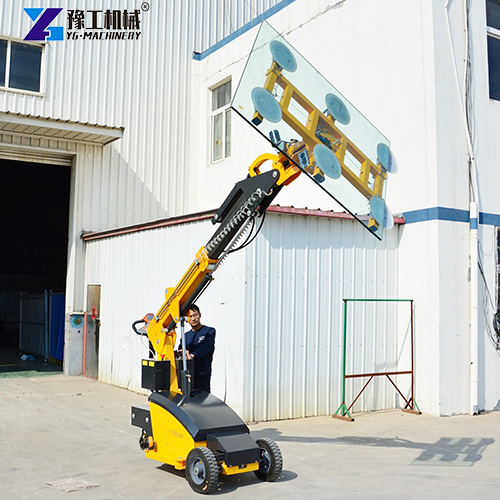
In curtain-wall and indoor glass installation work, picking the right equipment directly impacts construction efficiency, job-site safety, and overall project cost. Two popular solutions are widely used today: a mini crawler spider crane fitted with electric suction cups and the glass lifter machine. Each solution brings distinct strengths and suits completely different working conditions. This article gives an objective comparison covering equipment specifications, working performance, and operation methods, helping you select the best-fit option for your project.
Specifications
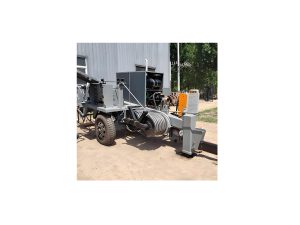
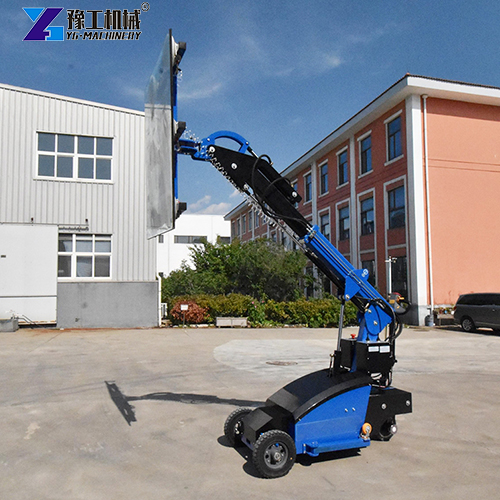
Glass lifter machine:
| Model Type | YG-LD-300 | YG-LD-400 | YG-LD-500 | YG-LD-600 | YG-LD-800 | |
| Load Capacity | 300kg(retract)150kg(extend) | 400kg(retract)200kg(extend) | 500kg(retract)250kg(extend) | 600kg(retract)300kg(extend) | 800kg(retract)400kg(extend) | |
| Lifting Height | 3500mm | 3500mm | 3700mm | 3700mm | 4500mm | |
| QTY of Suction Cap | 4pcs | 4pcs | 6pcs | 6pcs | 8pcs | |
| Rubber Suction Cap | 300mm | Ø300mm | Ø300mm | Ø300mm | Ø300mm | |
| Maintenance-free Battery | 2x12V/80AH | 2x12V/100AH | 2x12V/120AH | 2x12V/120AH | 2x12V/120AH | |
| Battery Charger | Smart Charger | Smart Charger | Smart Charger | Smart Charger | Smart Charger | |
| Drive motor | 24V/1200W | 24V/1200W | 24V/1200W | 24V/1200W | 24V/1200W | |
| Lifting Motor | 24V/2000W/6L | 24V/2000W/6L | 24V/2000W/6L | 24V/2000W/6L | 24V/2000W/12L | |
| Chassis L*W | 2660*810mm | 2660*810mm | 2800*810mm | 2800*810mm | 2800*810mm | |
| Driving Wheel | Ø250x80mm | Ø250x80mm | Ø300x100mm | Ø300x100mm | Ø300x125mm | |
| Packing Size(mm) | 2560*1030*1700 | 2560*1030*1700 | 2580*1050*1700 | 2580*1050*1700 | 3000*1250*2300 | |
| N.W/G.W | 1100/1150kg | 1280/1330kg | 1300/1350kg | 1400/1450kg | 1600/1650kg | |
| Loading Qty | 1x20GP/40GP: 6SETS/12SETS | |||||
| Movement | Automatic(4 kinds) | 1. The suction cup frame flips 180° electrically. 2. The support plate automatically retracts. 3. The hydraulic arm lifts electrically. 4. The base of the whole machine moves 100- 150 mm horizontally. | ||||
| Manual (2kinds) | 1. The suction cup holder can be manually rotated 90 degrees (electrically powered optional). 2. The suction cup holder can be manually rotated 360 degrees (electrically powered optional). | |||||
| Usages | Mainly used for the handling, movement, and installation of materials such as glass, marble, wood, iron plate, etc. | |||||
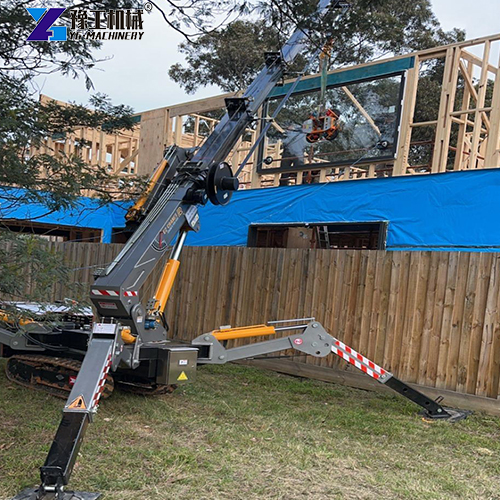
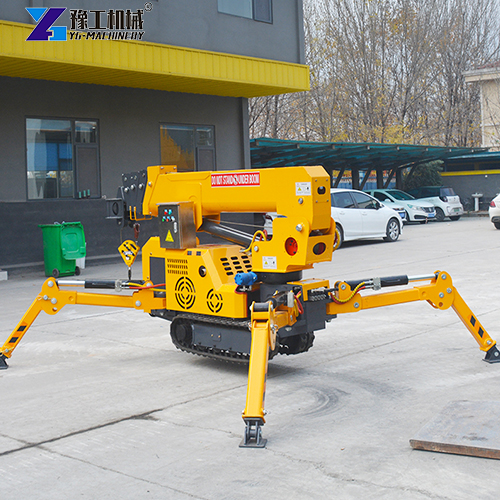
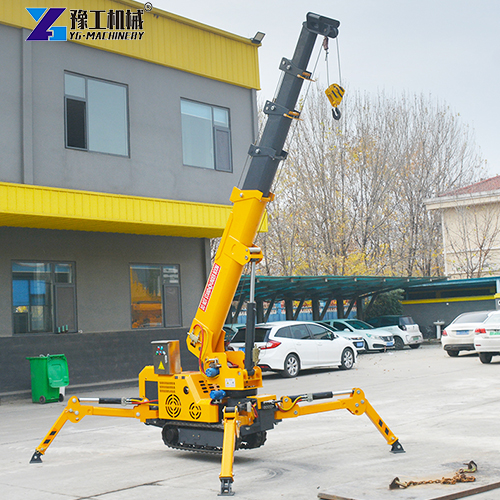
Mini crawler spider crane:
| Model | YG-3 | YG-5 | YG-8 | |
| Specification | 3t | 5t | 8t | |
| Maximum working radius | 8.83m×0.15t | 14m×0.5t | 16.5m | |
| Maximum above-ground head | 9.9m×0.7t | 16.8m | 18m | |
| Winch device | Hook Speed | 0-8m/min(4 rope) | 12m/min(4 rope) | 12m/min(4 rope) |
| Rope diameter | φ8mm×45m | Φ11mm×80m | Φ11mm×80m | |
| Telescopic system | Boom Type | 5-section boom, pentagonal structure | 5-section boom, pentagonal structure | 5-section boom, pentagonal structure |
| Boom Length/Time | 3.1m-9.2m/20sec | 12.3m/54sec | 12.3m/54sec | |
| Up and down | Boom Angle/Time | 0°~78°/13sec | 0°~78°/13sec | 0°~78°/13sec |
| Slew system | Slew Angle/Speed | 0-360°continuous/60sec | 0-360°continuous/38sec | 0-360°continuous/38sec |
| Traction system | Walking Way | Hydraulic motor drives | Hydraulic motor drives | Hydraulic motor drives |
| Walking Speed | 0~2.5km/h | 0~2.5km/h | 0~2.5km/h | |
| Grade Ability | (25°)36% | (25°)36% | (25°)36% | |
| Operating system | Operation type (Boom/outrigger) | Manual operation, manual walking(remote control option) | Manual operation, manual walking(remote control option) | Manual operation, manual walking(remote control option) |
| Operating characteristics | Manual operation, remote control | Manual operation, remote control | Manual operation, remote control | |
| Transport parameters | L*W*H(mm) | 2950*980*1560 | 5000*1500*1900 | 5000*1600*2180 |
| Total weight(kg) | 2700 | 6200 | 7200 | |
When to Choose Mini Crawler Spider Crane with Suction Cups?
A mini crawler spider crane with suction cups will be the better choice if most of these conditions apply to your project:
- Working at outdoor high positions such as building facades, roof skylights, and mid-high-rise curtain walls, with vertical lifting height over 5 m. YG-3 reaches 9.9 m lifting height; YG-5 / YG-8 can go above 16.8 m.
- The construction site has uneven ground, steps, or slopes. The tracked chassis of the mini crawler spider crane handles difficult terrain well, with maximum gradeability of 25°.
- Glass installation points sit far from the machine parking spot. You need long boom outreach to lift over obstacles. YG-8 offers a maximum working radius of 16.5 m.
- You need to lift glass from the ground up to upper floors. The wire rope length of a mini crawler spider crane can reach 45-80 metres.
- You already run a spider crane for other lifting tasks on-site. You only need extra suction cup attachments to reuse the existing unit.
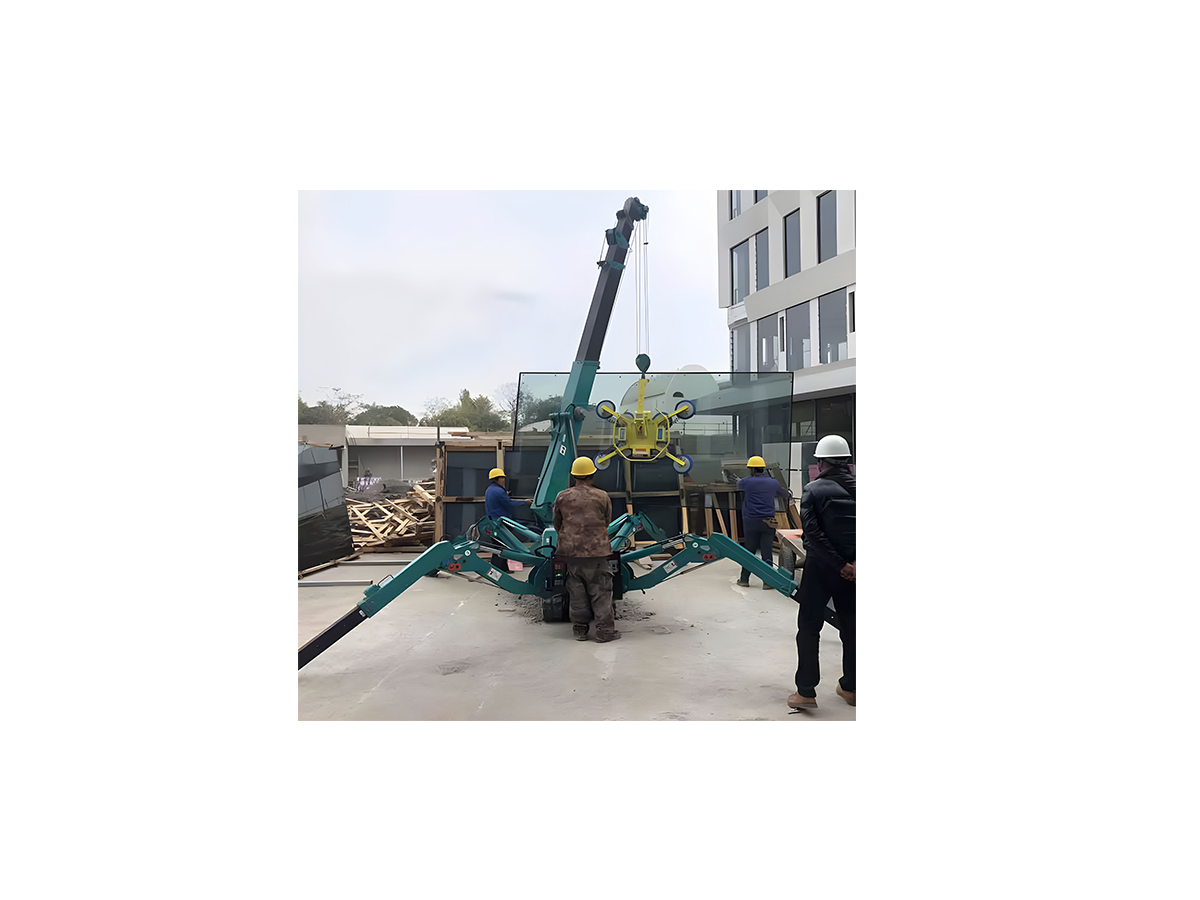
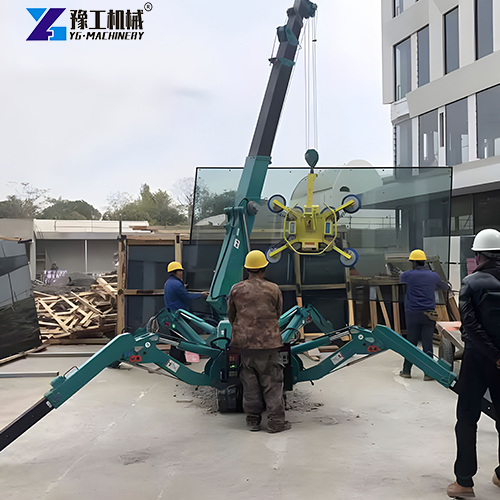
Project case: During glass installation for a hotel atrium, the construction team used a YG-5 mini crawler spider crane with electric suction cups. Thanks to its 14 m working radius and 16.8 m lifting height, crews precisely placed six pieces of 8-metre-high glass within only 3 hours. Traditional methods would take at least two days.
When to Choose a Glass Lifter Machine?
The glass lifter machine brings clear advantages when most of the following conditions match your project:
- Working indoors on flat solid floors such as shopping malls, office buildings, and factory workshops. Floor load-bearing capacity must support machine travel; unit weight ranges only from 1.1 ton to 1.65 ton.
- Glass needs horizontal transport from the stacking area to the installation position along clear, moderate-distance routes. Its chassis width is merely 0.81 m, so it passes through standard doorways.
- Large-angle repositioning is required during fitting work, for example, turning flat glass upright or flipping panels 180°. 360° electric rotation and 180° electric side flip of the suction frame complete these movements in one go.
- Limited on-site workers; you hope to cut labour costs via single-person operation.
- Long-term project with repeated machine use. The all-in-one unit delivers high efficiency and fast relocation.
- Very high installation precision is required, for example, fitting glass into grooves or deep mullions. Its rigid boom eliminates swinging errors caused by wire-rope flex, plus 100-150 mm horizontal fine adjustment.
- Glass weight within 800 kg and lifting height below 4.5 m.
Project case: For indoor glass partition installation inside a shopping mall, crews deployed the YG-LD-600 glass lifter machine. One operator finished moving and positioning one large glass panel in 10 minutes. Traditional manual work needed six workers and nearly 40 minutes for the same task.
Selection Reference
- If your job combines indoor location, low working height (within 4.5 m), horizontal transport, and frequent flipping, give priority to glass vacuum lifting equipment. Its integrated design and rigid boom deliver better accuracy and higher efficiency.
- If your project focuses on outdoor jobs, high lifting height (above 5 m), long-reach hoisting, and rough ground conditions, the tracked spider crane with suction cups works better. Its tracked undercarriage and telescopic boom cope well with harsh site environments.
- These two machines are not mutually exclusive. On real-world job sites, they often complement each other. You can use the tracked spider crane to lift glass up to target floors, then use glass vacuum lifting equipment for indoor horizontal transfer and precise fitting.
Operation Modes & Labour-cost Comparison
Operation workflow and manpower requirements make up a large part of total project cost. Clear differences exist between these two solutions.
Workflow for mini tracked spider crane with suction cups
- You first extend and level the four outriggers of the spider crane. This setup takes roughly 5-10 minutes.
- One crane operator controls boom extension, lift, and slew from the operator station. A second signalman or suction-cup operator stands on the ground guiding glass orientation.
- Before moving position, you must retract outriggers and fold the boom. After relocating, you extend outriggers again. This repeated cycle consumes extra time.
- During glass fitting, flexible wire-rope connections let glass swing under wind force or inertia. Extra workers are needed to steady and guide panels into place.
Workflow for heavy glass lifting equipment
- No outrigger deployment required. You start working right after power-on.
- One single worker holds the wireless remote controller to drive, lift, rotate, and flip all movements.
- The electric wheel-base can travel fully loaded while the glass stays attached. You can carry and fit panels continuously without repeated parking or re-setting steps.
- The rigid boom keeps glass locked in position with no swinging. Once you reach the target spot, hydraulic side-shift (100-150 mm) carries out fine-tuning down to millimetre level for final placement.
Labour-cost summary: A spider-crane solution normally needs 2-3 people: crane driver, signalman, and fitting helper. The heavy glass lifting equipment only requires one independent operator. Over long-duration projects, labour savings from this machine become very substantial.
No matter which solution you select, share key parameters such as glass dimensions, weight, installation height, ground condition, and working frequency with your equipment supplier before purchase. Ask professional engineers to assess site conditions and offer suitable configuration suggestions. Feel free to get in touch with us for detailed product brochures or on-site machine demonstrations.