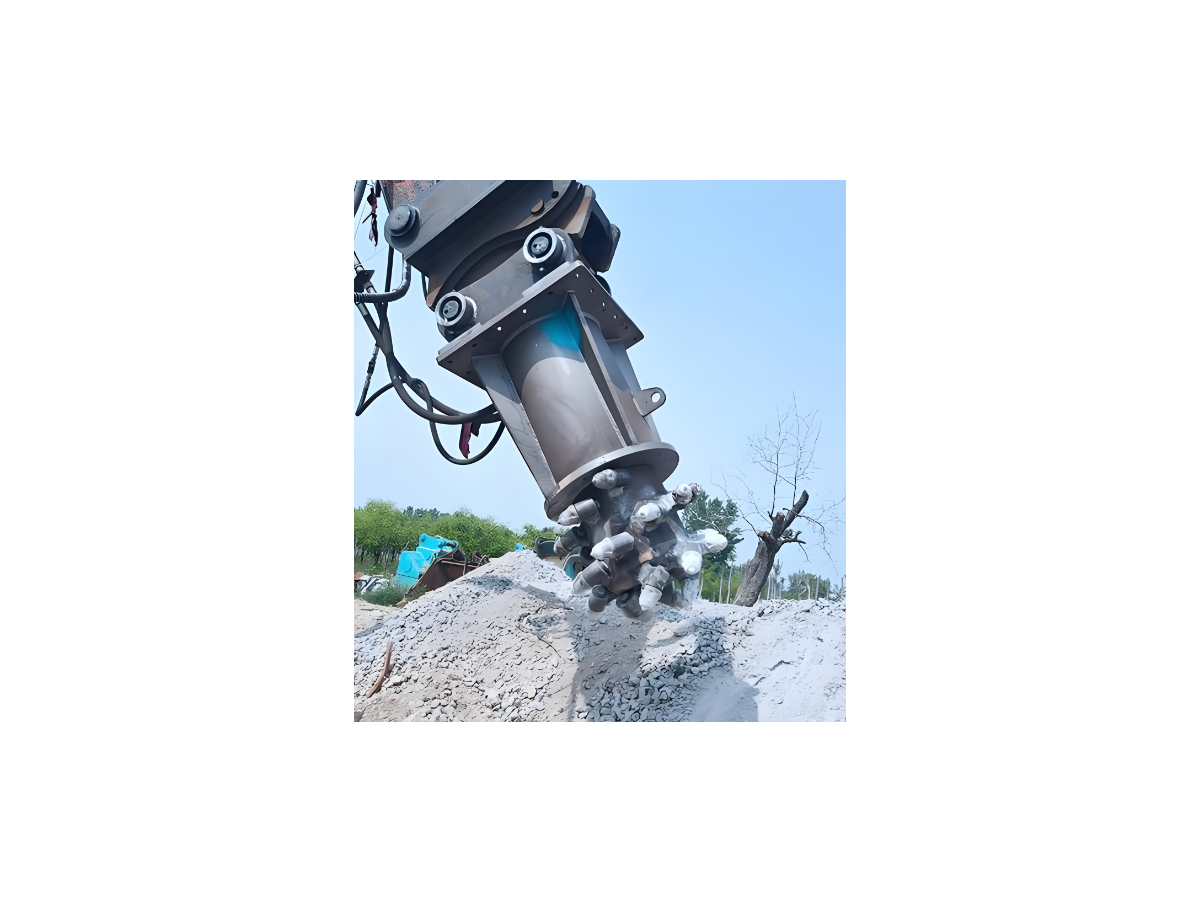

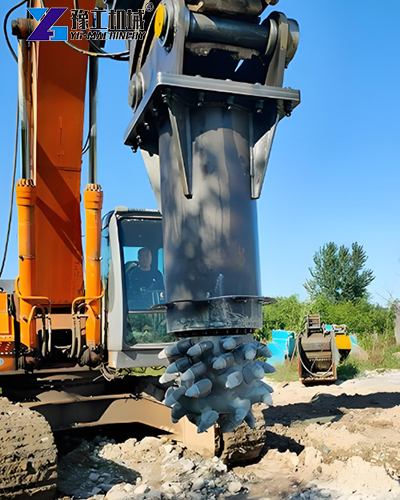
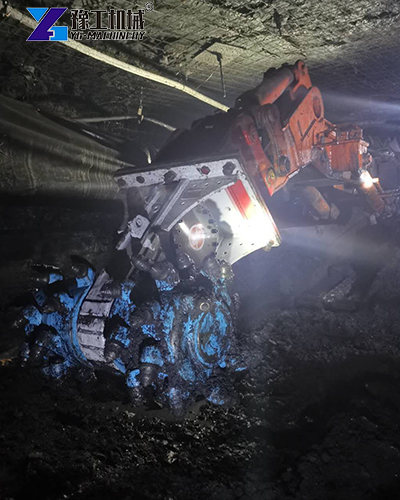
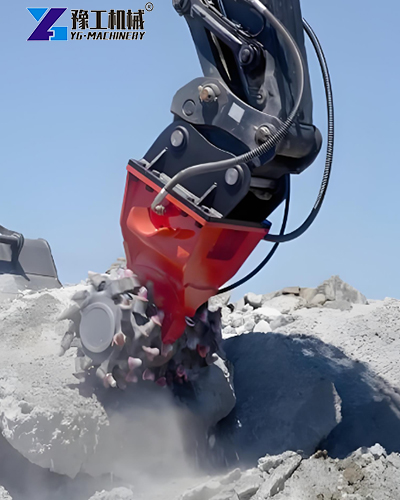
Different projects require milling equipment with different structures. The YG drum cutter for excavator series includes transverse, longitudinal, and chain-type no-blind-spot models, which are suited for wide-area milling, narrow-space cutting, and high-precision trenching, respectively. Whether the project is tunnel trimming, steel slag cleaning, pile head removal, rock excavation, or utility trenching, the right drum cutter attachment for excavator can help the construction team achieve higher efficiency and more consistent results.
What is a Drum Cutter for Excavator?
A drum cutter for excavator is a professional milling attachment driven by the excavator’s hydraulic system. The equipment usually converts hydraulic energy into stable rotating cutting force through a hydraulic motor, reduction mechanism, gear transmission, and high-strength picks to continuously mill rock, concrete, asphalt, frozen ground, steel slag, and other hard materials.
Unlike hydraulic breakers that rely on impact force to break material, a rotary drum cutter removes material layer by layer through a cutting drum or chain-type cutting mechanism. This method provides better control over the construction boundary, trench width, cutting depth, and surface flatness, and is especially suitable for jobs that require high precision or where large vibrations are not allowed.
A high-quality drum cutter attachment for excavator usually consists of the following parts:
- High-torque hydraulic motor, providing continuous power to the cutting head.
- Reducer or spur gear transmission system, for increasing output torque and ensuring stable power delivery.
- Milling drum, longitudinal cutting head, or chain-type cutting assembly, to suit different cutting directions and profile requirements.
- High-strength picks and pick holders, for directly cutting into rock, concrete, and other hard materials.
- Bearings, oil seals, and protective structures to cope with dust, mud, water, impact, and abrasive conditions.
- Mounting brackets, hydraulic hoses, and quick-coupling solutions that match the excavator.
The YG series milling heads can be used on rock with compressive strength up to about 90 MPa and can also work underwater. The equipment uses imported high-torque motors, imported bearings and oil seals, and high-strength spur gear transmissions to meet the demands of continuous operation in complex construction environments.
Three Structures of YG Drum Cutter Machine
YG offers three types of milling heads – transverse, longitudinal, and chain-type no-blind-spot – based on cutting direction, space constraints, and trench-forming requirements. These three structures are not simply different in size, but are professional cutting solutions designed for different project challenges.
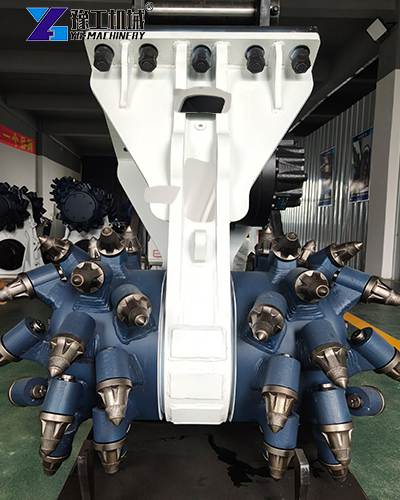
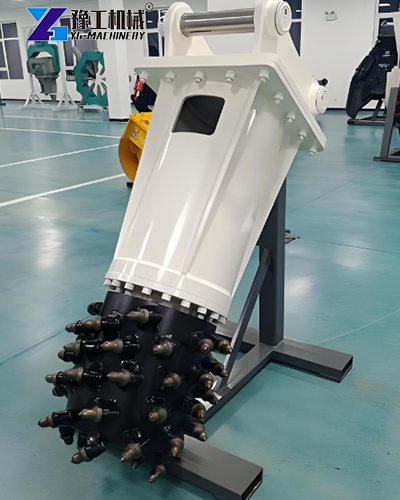
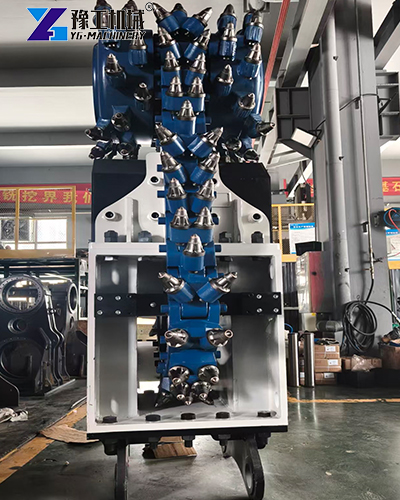
Transverse Milling Head: For Large Areas and Wide-Width Milling
| Product Model | Applicable Excavator (T) | Weight (kg) | Milling Width (mm) | Milling Head Diameter (mm) | Number of Cutters | Recommended Speed (r/min) | Recommended Flow (L/min) | Max Pressure (MPa) | Max Torque (NM) |
| HX – X1 | 6 – 9 | 450 | 420 | 340 | 40 | 95 | 80 | 35 | 4700 |
| HX – X2 | 10 – 18 | 550 | 650 | 450 | 56 | 85 | 120 | 35 | 7000 |
| HX – Z1 | 20 – 27 | 1100 | 850 | 560 | 64 | 78 | 220 | 35 | 14300 |
| HX – Z2 | 30 – 40 | 1250 | 950 | 660 | 64 | 75 | 320 | 35 | 23300 |
| HX – D | 45 – 60 | 2450 | 1150 | 850 | 60 | 55 | 360 | 35 | 40300 |
The transverse milling head is a widely used type of rotary drum cutter. Its cutting drum is arranged transversely, and under the control of the excavator’s arm and stick, it can continuously mill rock, concrete, pavement, and other hard materials.
This type of drum cutter attachment for excavator is suitable for trench excavation, tunnel trimming, building demolition and renovation, mining, and road construction. For projects that require handling large working areas, the transverse milling head can increase the milling coverage per unit time through reasonable pick layout and stable torque output.
The YG transverse milling head uses imported high-torque hydraulic motors, imported bearings and oil seals, and high-strength spur gear transmissions. The high-strength tools, combined with an installation sequence optimised through years of milling experience, help improve cutting efficiency and reduce ineffective friction and local overloading in hard materials.
The transverse milling head is especially suitable for the following tasks:
- Rock trenches, pipe trenches, cable trenches, and foundation trench excavation.
- Tunnel sidewalls, arches, floors, and profile trimming.
- Demolition of concrete walls, foundations, old building structures, and bridge components.
- Road rock subgrade treatment, side ditch construction, and old pavement milling.
- Open-pit mine rock stripping, ore body boundary trimming, and slope treatment.
- Urban projects where blasting is not suitable or vibration and noise are controlled.
- Underwater milling and trimming of rock, concrete, and foundation structures.
Longitudinal Milling Head: For Narrow Spaces and Directional Cutting
| Product Model | Applicable Excavator (T) | Weight (kg) | Milling Head Diameter (mm) | Number of Cutters | Recommended Speed (r/min) | Recommended Flow (L/min) | Max Pressure (Mpa) | Max Torque (NM) |
| ZX – 1 | 6 – 9 | 340 | 400 | 28 | 80 | 75 | 35 | 3780 |
| ZX – 2 | 10 – 18 | 480 | 450 | 32 | 80 | 120 | 35 | 7900 |
| ZX – 3 | 20 – 27 | 900 | 550 | 44 | 75 | 200 | 35 | 12700 |
| ZX – 4 | 30 – 40 | 1100 | 580 | 48 | 65 | 260 | 35 | 19600 |
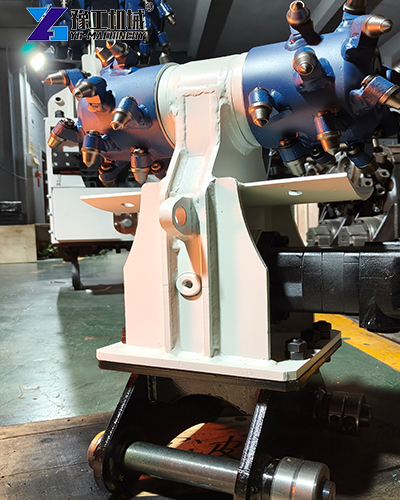
The cutting head of the longitudinal milling head is arranged along the longitudinal direction of the equipment, allowing it to enter narrow spaces more flexibly and perform precise cutting in specific directions and local areas. Compared with transverse models, the longitudinal milling head is more suitable for narrow trenches, deep areas, corners, and jobs that require directional trimming.
The YG longitudinal drum cutter machine is mainly used for special trench excavation, steel slag removal in the steel industry, pile head demolition, material mixing, and profile trimming. The equipment is equipped with imported hydraulic motors, high-torque reducers, and high-strength alloy tools, and can work continuously in high-load, dusty, highly abrasive, or space-limited environments.
To meet different project needs, the longitudinal milling head can be customised with extension shrouds of various lengths. This design helps the equipment reach working positions at specific depths, special angles, or restricted cross-sections, providing greater installation and operation flexibility for complex projects.
Typical applications of the longitudinal rotary drum cutter include:
- Narrow cable trenches, utility trenches, and local rock trench excavation.
- Steel slag removal in steel mills, slag treatment, and work in high-temperature residual areas.
- Pile head breaking, pile foundation trimming, and concrete foundation treatment.
- Local tunnel widening, corner cleaning, and structural profile trimming.
- Concrete demolition and building renovation in confined spaces.
- Mixing and treatment of accumulated materials, hardened materials, or specific industrial materials.
- Local cutting of underwater foundations, rock, or concrete structures.
Chain-Type Milling Head: No-Blind-Spot Precision Trenching Solution
| Technical Parameter | YG-700 | YG-1400 | YG-2200 |
| Maximum power | 70 kW | 140 kW | 220 kW |
| Maximum displacement | 240 ml/r | 450 ml/r | 600 ml/r |
| Motor rated pressure | 28 MPa | 28 MPa | 28 MPa |
| Maximum output torque | 12,000 N·m | 33,000 N·m | 38,000 N·m |
| Working flow | 180–240 L/min | 290–330 L/min | 480–540 L/min |
| Working speed | 70 r/min | 60 r/min | 70 r/min |
| Machine weight | 3,100 kg | 3,300 kg | 3,500 kg |
| Number of picks | 107 pcs | 107 pcs | 107 pcs |
| Pick specification | 30 | 30 | 30 |
| Suitable excavator | 18–23 t | 35–45 t | 45–70 t |
Traditional double-drum milling heads may have a cutting gap between the two drums. In precision trench work, operators often need to swing the equipment left and right to re-cut in order to remove the remaining material in the middle. This not only reduces efficiency but may also cause an uneven trench bottom or over-excavation.
The YG chain-type milling head uses a new no-blind-spot design that fills the gap in the middle area of ordinary milling heads. The equipment can form a continuous, complete, and flat cutting path without repeated left-right swinging, making it especially suitable for projects with strict requirements on trench shape, width, and bottom flatness.
This chain-type drum cutter attachment for excavator can also be mounted on 6–70 ton excavators, and can be used for trenching, tunnel trimming, building demolition, mining, and road construction hard-material milling tasks. Its high-torque motor, imported bearings and oil seals, and high-strength gear transmission allow the equipment to handle rock with compressive strength up to about 90 MPa, and it is also suitable for underwater environments.
The main advantages of the chain-type milling head include:
- No blind-spot cutting, reducing the middle residue found in traditional double-drum types.
- No need for frequent left-right swinging for re-cutting, improving trench-forming efficiency.
- Trench width does not exceed the milling head width, reducing over-excavation and backfilling work.
- More regular trench bottom and sidewalls, beneficial for subsequent pipe laying and foundation construction.
- Suitable for confined spaces, underground utility projects, and jobs requiring high-precision forming.
- Can handle rock, concrete, frozen ground, asphalt, and other hard materials.
- Can be used in underwater environments, providing a controllable cutting solution for water-related foundation projects.
How to Choose Between Transverse, Longitudinal, and Chain-Type Drum Cutter for Excavator?
| Selection Factor | Transverse Milling Head | Longitudinal Milling Head | Chain-Type Milling Head |
| Suitable working surface | Wide planes, trenches, tunnel sections | Narrow spaces, deep areas, corners | Trenches with strict width and profile requirements |
| Main construction goal | Rapid coverage of large areas and profile trimming | Fine directional cutting and special-position work | Continuous no-blind-spot cutting and regular trench forming |
| Trenching performance | Suitable for regular and wider trenches | Suitable for narrow trenches and local cutting | Especially suitable for high-precision, low-over-excavation trenches |
| Typical applications | Tunnels, roads, mines, demolition, rock excavation | Steel slag, pile heads, special trenches, local trimming | Cable trenches, pipe trenches, underground works, tunnel finishing |
| Need for re-cutting | Depends on trench and drum structure | Depends on cutting direction and work position | No-blind-spot design reduces left-right re-cutting |
If the project is mainly large-scale rock treatment, tunnel trimming, or concrete demolition, the transverse rotary drum cutter is usually a more balanced choice. If the working space is narrow, or you need to cut special parts or work in deep trenches, the longitudinal drum cutter machine offers greater flexibility. If the project focuses on cable trenches, pipe trenches, or other jobs with strict trench shape requirements, the YG chain-type no-blind-spot milling head can better leverage its advantages.
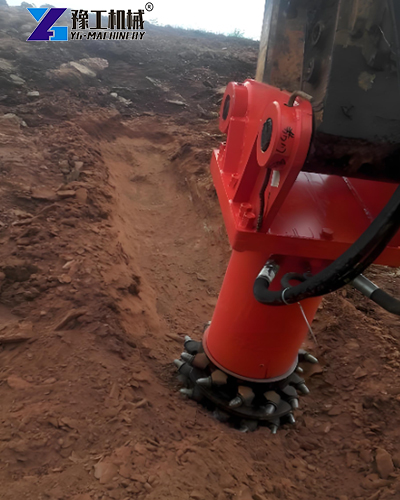
Speak with Our Product Manager
5 Major Advantages of Drum Cutter Attachment for Excavator
Less Over-Excavation, Lower Backfilling Costs
Traditional breakers can easily cause irregular breakage and loss of boundary control in rock excavation, often requiring subsequent manual trimming and extra backfilling. The drum cutter attachment for excavator can perform layered milling according to the designed alignment, making it easier to control the excavation boundary and trench dimensions.
In particular, the YG chain-type milling head, with its no-blind-spot structure, reduces middle residual material without frequent left-right re-cutting, helping to control trench width and reduce unnecessary earth excavation and backfill material consumption.
Better Suited for Vibration-Sensitive Areas
When working near urban underground projects, hospitals, schools, residential areas, bridges, historical buildings, or existing pipelines, blasting and heavy breakers may be restricted by vibration and noise limits. The rotary drum cutter uses continuous cutting instead of high impact breaking, reducing disturbance to the surrounding environment and existing structures.
Improved Surface and Profile Quality
The milling head can be used for tunnel profile trimming, slope treatment, concrete surface milling, and trench bottom cleaning. The more regular cutting results can reduce subsequent manual chiselling, bottom cleaning, and trimming work, improving overall project quality and schedule control.
Suitable for Complex Materials
The YG drum cutter machine can handle rock, concrete, frozen ground, asphalt, steel slag, and other hard materials. For rock with compressive strength up to about 90 MPa, the equipment can achieve stable cutting through its high-torque hydraulic system and wear-resistant picks.
It should be noted that actual productivity is affected by material hardness, rock joints, abrasiveness, cutting depth, excavator hydraulic capacity, pick wear, and operating methods. Therefore, provide as complete working-condition information as possible before purchase.
Supports Underwater Work
All YG milling heads – transverse, longitudinal, and chain-type – can be used underwater. The imported bearings and oil seals, together with the reliable transmission structure, help the equipment adapt to water-immersed, muddy, and wet conditions.
For projects such as river training, port construction, bridge foundations, dam maintenance, and underwater rock removal, it is recommended to confirm the actual water depth, working medium, hydraulic hose configuration, and maintenance requirements before purchase, so that a suitable underwater construction plan can be made.
How to Choose the Right Drum Cutter Machine?
Before purchasing a drum cutter for excavator, it is recommended to carry out technical checks on the following aspects:
- Confirm the excavator tonnage, boom carrying capacity, and attachment mounting dimensions.
- Check the actual working flow, pressure, return oil back pressure, and cooling capacity of the auxiliary hydraulic system.
- Confirm the type of working material, including rock compressive strength, concrete strength, steel slag characteristics, abrasiveness, and water content.
- Clarify the required trench width, trench depth, milling depth, and final profile requirements.
- Determine whether the project is in a sensitive construction environment with low vibration, low noise, confined spaces, or proximity to existing structures.
- Choose a transverse, longitudinal, or chain-type no-blind-spot structure according to the cutting direction.
- Evaluate pick replacement convenience, spare parts supply, maintenance intervals, and after-sales technical support.
- If underwater work is needed, confirm the sealing configuration and special maintenance plan in advance.
For example, a 35-ton excavator used for rock trimming on tunnel sidewalls and local concrete demolition – if the working face is wide and large coverage is needed, the HX-Z2 transverse milling head can be considered first; if the main task is precise narrow trenching, corner cleaning, or local area work, the ZX-4 longitudinal milling head may be chosen; if the project requires a utility trench with strictly controlled width and a continuously flat bottom, the YG-1400 chain-type no-blind-spot milling head is a more targeted option.
Operation and Maintenance Suggestions
Correct operation and regular maintenance are important conditions for keeping a rotary drum cutter running stably over the long term.
- Before work, check that the excavator auxiliary hydraulic flow and pressure match the milling head model.
- Check that hydraulic hoses, quick couplings, seals, mounting brackets, and fixing bolts are secure.
- In hard rock conditions, adopt a layered, continuous, and steady feeding method; avoid cutting too deep in one pass.
- Do not rely on the full weight of the excavator to force the cutting head down, as this may overload the picks, motor, or transmission.
- Regularly check pick wear, looseness, loss, or breakage, and replace failed picks in time.
- Maintain reasonable working flow and hydraulic oil temperature; avoid prolonged high-load operation that may cause system overheating.
- Check gear transmission, bearings, oil seals, and lubrication status according to maintenance requirements.
- After underwater work, clean the equipment promptly and pay special attention to seals, bearings, and hydraulic connections.
- Use original or matching-specification wear parts to maintain cutting efficiency and equipment safety.
Frequently Asked Questions about Drum Cutter for Excavator
Q: What materials can the milling head handle?
YG milling heads can be used for cutting, trimming, and demolishing rock, concrete, frozen ground, asphalt, steel slag, and other hard materials. The transverse, longitudinal, and chain-type structures are suitable for different cutting directions, working surfaces, and trench accuracy requirements.
Q: Why is the chain-type milling head suitable for utility trenches?
The chain-type YG milling head has a no-blind-spot design that fills the cutting gap found in ordinary double-drum milling heads. It can form a more continuous and regular trench without repeated left-right re-cutting, and the trench width does not exceed the milling head width, making it especially suitable for cable trenches, fibre-optic trenches, gas pipeline trenches, and drainage ditches.
Q: How can I confirm whether my excavator can install a milling head?
You need to provide the excavator tonnage, brand and model, auxiliary hydraulic flow, working pressure, return oil pressure, stick connection dimensions, and information about the material to be worked on. The supplier can then recommend a suitable drum cutter attachment for excavator and confirm whether extra hydraulic hoses, cooling systems, or custom mounting brackets are needed.
Q: What about pick life and replacement costs?
YG milling heads use high-strength alloy picks; the transverse/longitudinal series have 28–64 picks each, while each chain-type model is equipped with 107 picks. The picks use a modular quick-change design and can be replaced quickly on site.
Choose YG Drum Cutter for Excavator
YG offers three professional milling head solutions – transverse, longitudinal, and chain-type no-blind-spot – covering hard-material cutting needs for 6–70 ton excavators. The transverse models are suitable for high-efficiency, large-area milling; the longitudinal models are suitable for narrow spaces and special directional work; and the chain-type models provide a more professional solution for high-precision, no-blind-spot trenching.
Whether you are looking for a drum cutter for excavator for rock excavation, tunnel trimming, steel slag cleaning, pile head removal, concrete renovation, mining, or underwater work, YG can recommend the right equipment based on your excavator model, hydraulic parameters, material strength, and construction goals.
Feel free to contact us. Provide your excavator tonnage, auxiliary hydraulic flow, pressure parameters, material type, trench dimensions, and on-site photos, and we will match you with the suitable milling head solution.