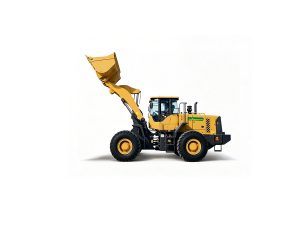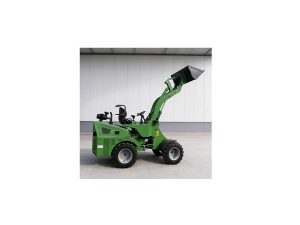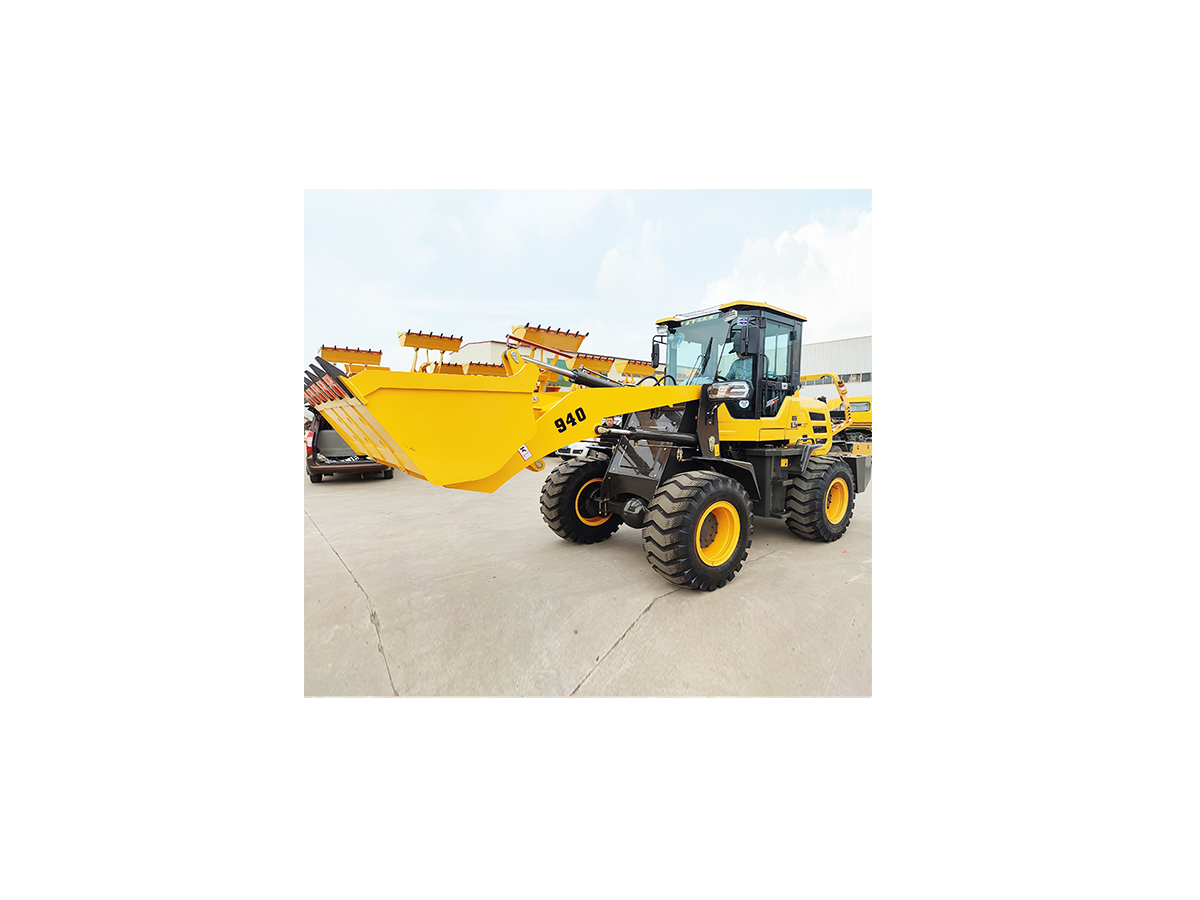

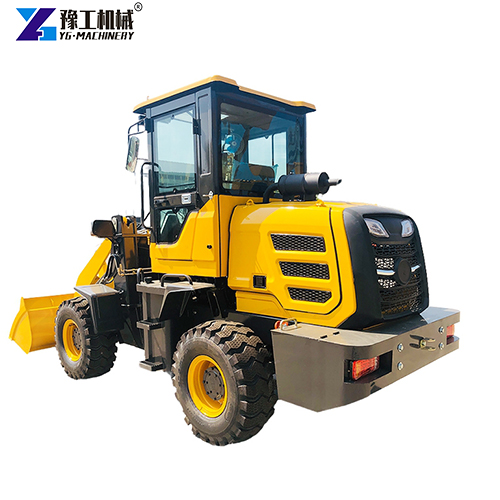
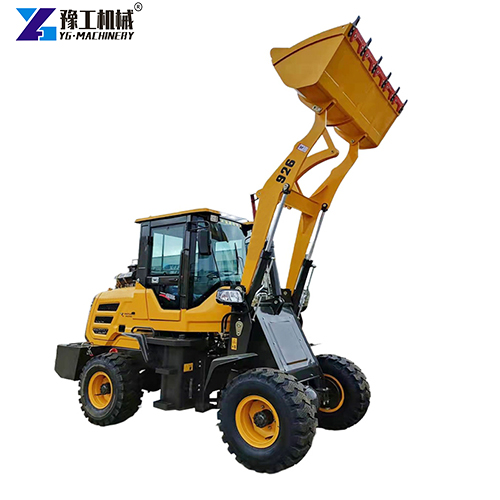
Mines, farms, ports, and construction sites all share one common yellow “iron warrior” seen nearly everywhere. It can scoop and load sand and gravel, haul forage, and clear snow in winter. This machine is a construction wheel loader. As one of the most versatile members of construction machinery, a well-matched construction wheel loader can drastically boost material handling efficiency and cut labor costs. However, faced with dozens of models, transmission types, and attachment options, many buyers do not know where to start. This guide covers technical parameters, transmission systems, working condition matching, power selection, and common troubleshooting, delivering an easy-to-understand purchasing guide for you.
Parameters of Construction Equipment Wheel Loader
Diesel Model Parameters
| Parameter \ Model | 920 | 926 | 928 | 930 | 940 | 946 | 949 |
| Transmission Mode | Mechanical Control | CVT | CVT | CVT | CVT | CVT | CVT |
| Dumping Height (m) | 3.2 | 3.2 | 3.2 | 3.2 | 3.5 | 3.5 | 3.5 |
| Standard Bucket | 1.8 m | 1.8 m | 1.8 m | 1.8 m | 2 m | 2 m | 2 m or 2.2 m |
| Gearbox | High & Low Speed | 265 Single High-Low Speed | 265 Dual High-Low Speed | 265 Dual High-Low Speed | 265 Dual High-Low Speed | 280 Dual High-Low Speed | 300 Split Dual High-Low Speed |
| Drive Axle | Isuzu | Isuzu | Small Planetary Axle | Small Planetary Axle | Large Planetary Axle | Large Planetary Axle | Large Planetary Axle |
| Engine | Weifang 490 | Weifang 490 | Weifang 490 | Turbocharged Weifang 4102 | Turbocharged Weifang 4102 | Turbocharged Weifang 4102 | Turbocharged Weifang 4108 |
| Tires | 20.5-16 | 20.5-16 | 20.5-16 | 20.5-16 | 1670-20 | 1670-20 | 1670-24 |
| Control Handle | Single Lever Control | Single Lever Control | Single Lever Control | Single Lever Control | Single Lever Control | Single Lever Control | Single Lever Control |
| Brake Type | Hydraulic Brake | Hydraulic Brake | Air Brake | Air Brake | Air Brake | Air Brake | Air Brake |
| Articulation Angle (°) | 25 | 25 | 25 | 25 | 30 | 45 | 45 |
Electrical Model Parameters
| Category | Item | Parameter Value |
| Performance | Rated Load (t) | 0.8 |
| Bucket rated capacity (m³) | 0.3 | |
| Dumping height (mm) (at 45°) | 1780 | |
| Lifting Height (mm) | 3140 | |
| Dumping Reach (mm) | 980 | |
| Max. Lifting weight (kg) | 600 | |
| Max. Excavation Force (kn) | 1000 | |
| Max. Grade ability | 30° | |
| Max. Turning Angel | 38°±1 | |
| Swing degree of the rear axle | 7° | |
| Dimensions & Weight | Overall length (Bucket on Ground position) (mm) | 3840 |
| Bucket width (overall width) (mm) | 1160 | |
| Overall Height (mm) | 2330 | |
| Wheel base (mm) | 850 | |
| Min Ground Clearance (mm) | 240 | |
| Net Weight (kg) | 1980 | |
| Radius of Turning Circle (mm) | 2610 | |
| Battery | Battery Model No. | 6-EVF-203A |
| Rated capacity (3hr) | 200Ah | |
| No. of battery groups | 12 | |
| Rated Voltage | 72V | |
| Working hours (h) | 4–5 | |
| Hydraulic System | Motor No. | CBHV |
| Voltage | 72V | |
| Power | 5000W |
Transmission System of YG Construction Wheel Loader: Mechanical Transmission vs CVT
The transmission system acts as the core power delivery unit of the heavy equipment front loader, directly shaping operating experience and applicable working scenarios. YG provides two transmission solutions for customers to choose from:
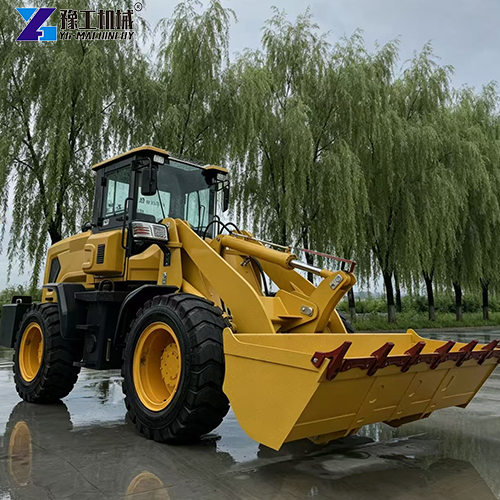
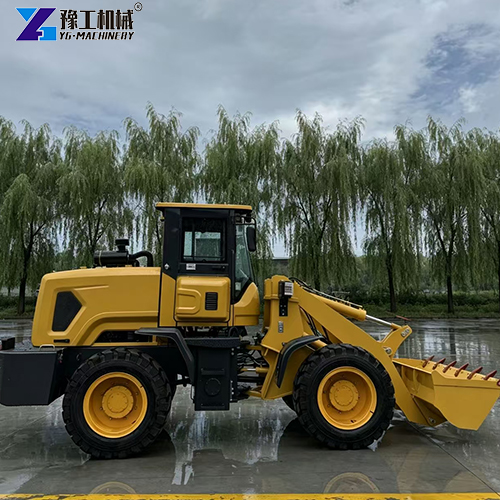
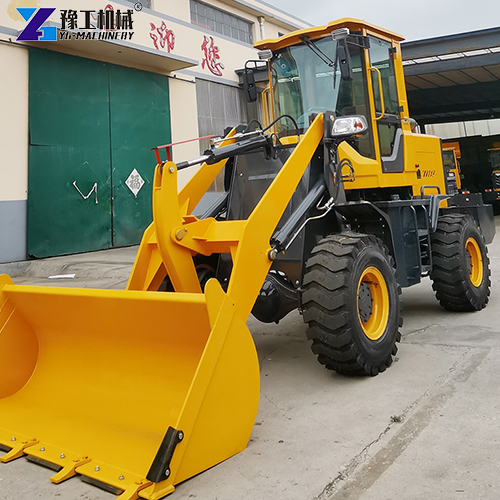
Mechanical Transmission (MT, hydrodynamic mechanical transmission) works by boosting engine torque via a torque converter before shifting gears through a mechanical gearbox. It features high transmission efficiency, mature and durable structure, low maintenance costs, and no stall under heavy startup loads, making it ideal for medium-to-large loaders and heavy-duty export models. Take the YG920 as an example. This 2-ton class construction wheel loader adopts mechanical transmission paired with Isuzu axles and a Weifang 490 engine, with a 25° articulation angle. Its simple, reliable structure makes it extremely popular on farms and small sand yards across Southeast Asia and Africa. Buyers value its practical advantage of easy repairs and readily available spare parts.
Continuously Variable Transmission (CVT, hydrostatic transmission) transfers power through a combination of variable displacement pumps and variable motors without fixed gears, enabling smooth stepless speed adjustment. Its strengths include simple operation, gear shifts without jerk, lower fuel consumption, reduced noise, and a more comfortable driving experience, commonly seen on small loaders, electric loaders, and light-duty municipal sanitation operations. Series YG926, YG928, and YG930 all come with CVT configuration matched with 265 dual high-low speed gearboxes. Operators only need to push a single control lever to move forward, reverse, and adjust speed, eliminating frequent clutch pressing and gear shifting and greatly lowering work fatigue. As the flagship 3-ton model, the YG930 series is fitted with a turbocharged Weifang 4102 engine, 25° articulation angle, standard air brakes, and large planetary axles. It delivers sufficient traction at sand yards and construction sites while keeping drivers comfortable during long shifts.
Your transmission choice defines machine operation and suitable working conditions. Pick a mechanical transmission if you prioritize durability and heavy load capacity. Choose CVT for superior operating comfort and fuel economy. If you regularly operate on rough terrain such as mines and quarries, heavy-duty transmission configurations with higher efficiency are recommended. Matched with large planetary axles that output powerful torque, the construction equipment wheel loader can travel steadily across muddy and gravel surfaces.
What Working Conditions Can the YG Construction Wheel Loader Handle?
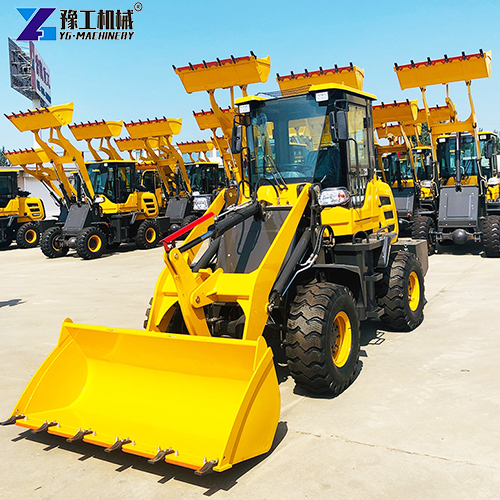
The practical value of a construction wheel loader largely depends on how many types of operations it can cover. YG’s full lineup of construction equipment wheel loaders ranges from the 2-ton 920 to the 4.9-ton 949. Equipped with different attachments and drive axle setups, these machines flexibly tackle all material handling tasks across multiple industries.
Agriculture
The 2-ton YG920, with a 3.2-meter dumping height and a 1.8 cubic meter standard bucket, serves grain farmers as a reliable helper for grain loading and unloading during harvest seasons, cutting down transfer cycles drastically. Livestock breeders use it to quickly move forage and feed, and efficiently clear livestock waste to maintain clean farm environments. Mixed farms rely on it for land leveling, material hauling, and auxiliary construction to complete diverse farming tasks with one machine.
Industry & Construction
Construction and industrial sites account for the largest share of loader applications. At sand and stone yards, the 3-ton YG930 fitted with a turbocharged Weifang 4102 engine and 1.8m³ bucket can load and transport nearly 100 tons of sand and gravel per hour. For coal yard operations, YG940 and YG946 stand out as core handling equipment, with a 4-ton rated load, 2m³ standard bucket, and 3.5-meter dumping height. Large planetary axles deliver ample traction on soft coal piles, while air brake systems guarantee safe braking when traveling downhill with full loads. On construction sites, YG928 and YG930 feature flexible articulated steering and single-lever control, allowing operators to maneuver easily within tight job zones for construction waste removal, concrete mixing, feeding, and site leveling.
Forestry & Warehousing
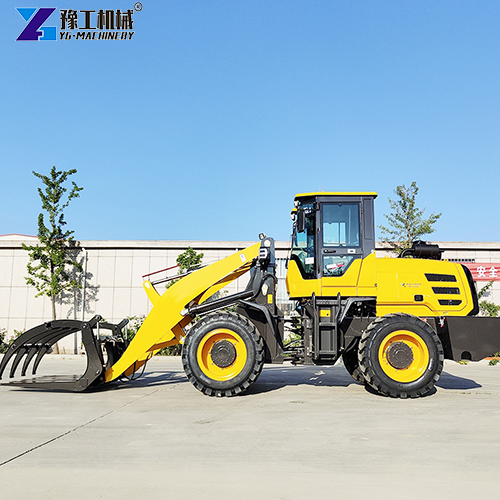
At timber mills, YG construction equipment wheel loader fitted with professional log grapple attachments rapidly grabs and loads raw and processed lumber. Large planetary axles deliver excellent off-road performance on muddy sites to lift wood transport efficiency significantly. At ports and warehouses, the YG940 and YG946 series offer over 4 tons of load capacity and a 3.5-meter dumping height, easily connecting with all transport vehicles for short-distance hauling of heavy goods.
Municipal & Environmental Protection
In winter, snow removal and dozer attachments can be quickly installed to efficiently clear snow on urban main roads, plazas, and airport runways. For snow removal work, the 3.5-meter dumping height and wide-angle articulated steering of YG930 and YG940 expand the snow clearing coverage per pass. In daily use, they handle the loading and transport of loose materials, including sand, gravel, and muck, with great flexibility.
To fit these diverse work scenarios, YG construction equipment loader supplies a full range of attachments: standard buckets for bulk sand, stone and dirt; grain-specific buckets engineered for granaries and farms with large volume and minimal residue; grapples and rotating grabs for timber, crop straw and scrap metal; bale clamps for moving hay bales and cotton bundles; pallet forks and stone lifting forks for cargo and stone stacking; high-efficiency snow blowers for road and factory snow removal. One main machine paired with multiple attachments truly realizes multi-purpose functionality.
Diesel vs Electric Construction Equipment Loader: How to Choose Power Sources
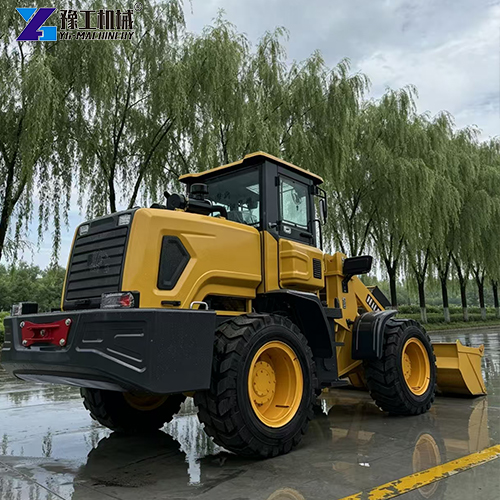
Rising environmental standards and accelerated electrification push more buyers to decide between diesel loaders and electric construction equipment loaders. YG also offers compact electric models (0.8-ton class, 72V battery, 200Ah capacity, 4–5 hours of continuous operation), ideal for indoor workspaces and locations with strict emission limits.
Diesel Loaders
Advantages: Long continuous runtime, convenient refueling, and consistent stable power output. Perfect for remote worksites far from power grids, such as mines and quarries, and heavy-duty tasks requiring nonstop, long-hour operation.Disadvantages: Higher fuel and maintenance costs, plus exhaust emissions.
Electric Loaders
Advantages: Zero emissions, low noise, far lower running costs as electricity expenses are much cheaper than fuel bills. Highly suitable for grain depots, indoor warehouses, and livestock farms sensitive to noise and pollution.Disadvantages: Restricted by current battery technology, electric loaders are only available in small sizes for now. Runtime and charging accessibility remain key considerations.
Simple selection rule: Choose diesel engines for outdoor heavy loads, long continuous shifts, and remote locations. Pick electric motors for indoor work, strict environmental requirements, and light short-distance transport.
FAQ about Construction Wheel Loader
Q1: What do “rated load” and “bucket capacity” of a construction equipment loader mean?
Rated load refers to the maximum weight of materials a heavy equipment front loader can safely and steadily lift under standard working conditions, measured in tons (e.g., the 920 belongs to the 2-ton class). Bucket capacity means the volume of materials the bucket can hold, measured in cubic meters (m³). When selecting models, match parameters based on material density (sand ≈1.6 tons/m³, stone ≈1.8 tons/m³) and actual loading demands. Use smaller buckets for dense heavy materials and larger buckets for light loose materials.
Q2: What are the key differences between the 920, 930, and 940 series heavy equipment front loaders?
These numbers stand for the machine’s rated load class: 920 = 2-ton, 930 = 3-ton, 940 = 4-ton. Major differences lie in overall machine weight, engine power, bucket capacity and applicable working conditions.
- 920: Light-duty work at small farms and livestock sites
- 930: Most widely used general-purpose model for sand yards and construction sites with medium workloads
- 940 and above: Heavy-duty harsh environments, including mines and quarries
Q3: How to pick suitable tires for your machine?
Two main options are available:
- Pneumatic tires: Provide good shock absorption and traction, fit standard road surfaces, ports, and general job sites.
- Solid tires: Extremely wear-resistant and puncture-proof, built for harsh sites full of broken stones and sharp debris. Final choice depends on your specific working conditions and procurement budget.
Q4: How to choose between long-wheelbase and short-wheelbase construction equipment loader?
Wheelbase is the distance between the centers of the front and rear wheels, directly impacting machine stability and maneuverability.
- Short wheelbase (compact & agile): Small turning radius for tight-space work, such as sand yards, indoor docks, and biomass power plant cotton waste transport.
- Long wheelbase (heavy-duty stable): Higher tipping load, superior driving stability, and strong anti-tipping performance, suitable for mining, log hauling, and loading large heavy rock blocks.
Q5: What is the product lead time?
Standard models are usually in stock with a lead time of only 2 to 4 weeks. Custom-configured machines generally take 2 to 3 months, depending on specifications.
Contact YG
If you need more product details or professional selection advice for the YG construction wheel loader, feel free to contact us anytime. We deliver one-stop services covering model recommendation, working condition analysis, and after-sales technical support.