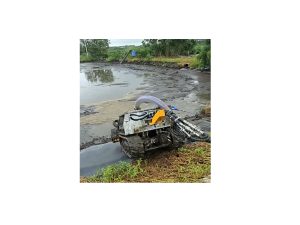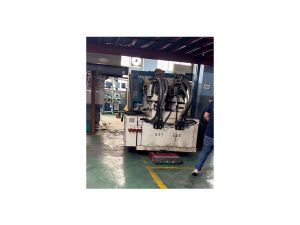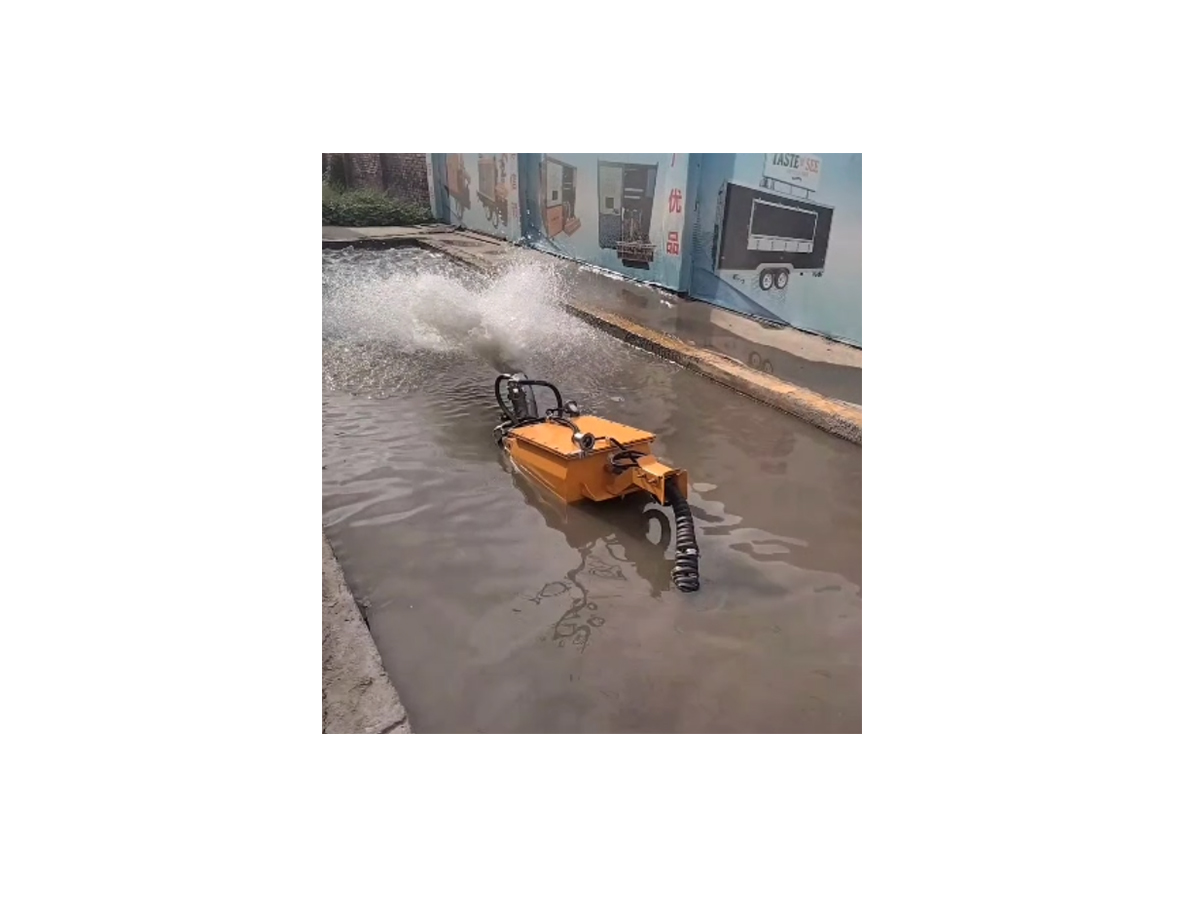

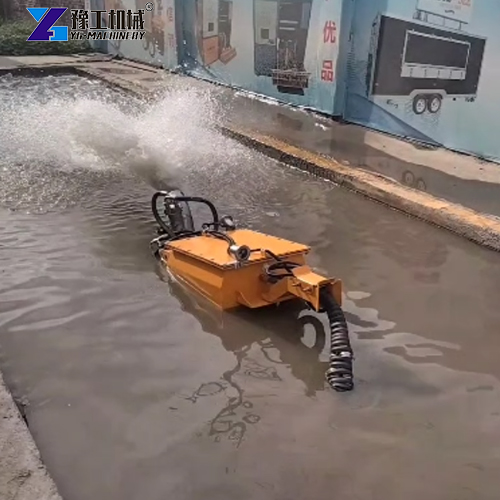
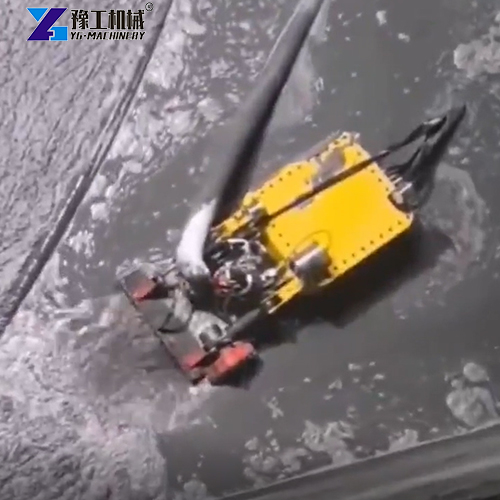
A salmon farm in British Columbia, Canada, has several interconnected ponds covering about 8 hectares in total. Over the years, feed residue and fish waste have built up on the pond bottoms, with sludge reaching over 1.2 meters thick in some areas. The accumulated sludge reduced water volume and affected water quality. The farm used to drain the ponds and send workers in to clean each year manually, but it was slow and required stopping feeding during the process. In early 2026, the farm brought in YG Machinery’s sludge transport robot to handle the pond sediment removal.
Hydraulic Dredging Robot Specifications
| Model | YG500 Electric | YG600 Electric | YG700 Electric | YG800 Electric | YG900 Electric | YG1200 Electric |
| Robot Dimensions | 1500×500×650 mm | 1500×600×650 mm | 1600×700×650 mm | 1600×850×700 mm | 1650×960×750 mm | 1900×1200×750 mm |
| Slurry Pump Model | 3E-100Z170 | 3E-100Z170 | 4E-250ZJ45 | 4E-250ZJ45 | 4E-250ZJ45 | 4C-200Z125 |
| Cleaning Width | 500 mm | 600 mm | 700 mm | 800 mm | 900 mm | 1200 mm |
| Track Speed | 3–15 m/min | 3–15 m/min | 3–15 m/min | 3–15 m/min | 3–15 m/min | 3–15 m/min |
| Robot Weight | — | — | — | — | — | 500 kg |
| Pump Inlet Size | 3 inch | 3 inch | 4 inch | 4 inch | 4 inch | 5 inch |
| Pump Flow Rate | 100 m³/h | 100 m³/h | 160 m³/h | 160 m³/h | 200 m³/h | 200 m³/h |
| Pump Head | 0–30 m | 0–30 m | 0–25 m | 0–25 m | 0–25 m | 0–25 m |
| Hydraulic Station Dimensions | 2200×1200×1700 mm | 2200×1200×1700 mm | 2200×1200×1700 mm | 2200×1200×1700 mm | 2200×1200×1700 mm | 2120×1240×1200 mm |
| Main Motor Power | 18 kW | 18 kW | 22 kW | 22 kW | 22 kW | 45 kW |
| Hydraulic System Pressure | 0–16 MPa | 0–16 MPa | 0–16 MPa | 0–16 MPa | 0–16 MPa | 0–16 MPa |
| Max Particle Size | 15 mm | 15 mm | 40 mm | 40 mm | 50 mm | 60 mm |
| Winch Speed | 0–10 r/min | 0–10 r/min | 0–10 r/min | 0–10 r/min | 0–10 r/min | 0–10 r/min |
| Standard Hydraulic Hose Length | 50 m | 50 m | 50 m | 50 m | 50 m | 50 m |
| Control System | Wireless Remote Control | Wireless Remote Control | Wireless Remote Control | Wireless Remote Control | Wireless Remote Control | Wireless Remote Control |
| Lighting System | 2× Underwater LED Lights | 2× Underwater LED Lights | 2× Underwater LED Lights | 2× Underwater LED Lights | 2× Underwater LED Lights | 2× Underwater LED Lights |
Customer Needs: What Challenges Did the Farm Face?
The main need was to remove accumulated sediment from the salmon ponds. Here are the specific conditions:
- Special sludge composition: The bottom deposits were mainly fish feed residue, fish waste, and a little sand, with high organic content. The sludge was semi-fluid with poor flowability, and regular suction equipment tended to clog.
- Limited working space: The ponds were 2–4 meters deep, with aeration pipes and drainage outlets on the bottom. Dredging boats couldn’t enter the ponds, and manual cleaning required draining the water first, which took a long time and interrupted farming operations.
- Strict environmental rules: Canadian fishery regulations strictly limit what can be discharged into fish habitats. The dredging process could not cause secondary water pollution, and the sludge had to be collected and handled properly.
- Special climate conditions: Winter temperatures in the area can drop to -15°C, and the ponds stay frozen for up to 4 months. The customer needed a mechanized dredging system that could run in cold weather and be operated remotely.
The customer made it clear they wanted equipment that could work year-round, be controlled remotely, and have a reliable sludge conveying system. They also hoped the materials would resist long-term corrosion in freshwater conditions.
YG Solution: How the Sludge Transport Robot Met Their Needs
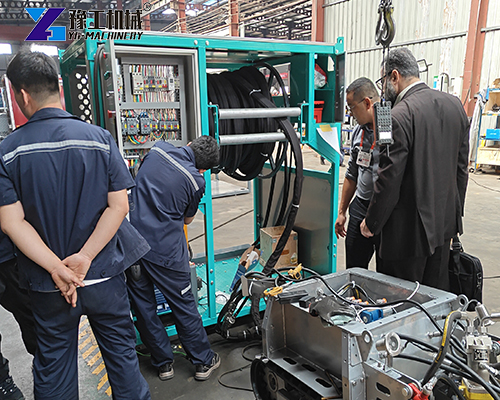
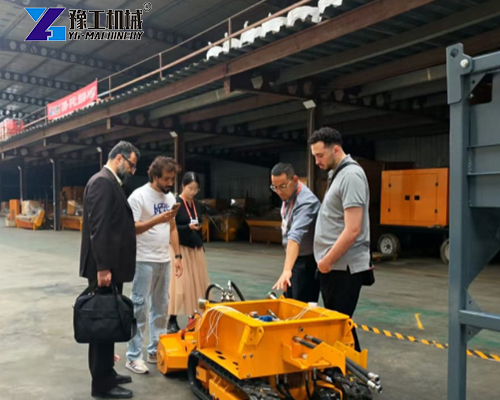
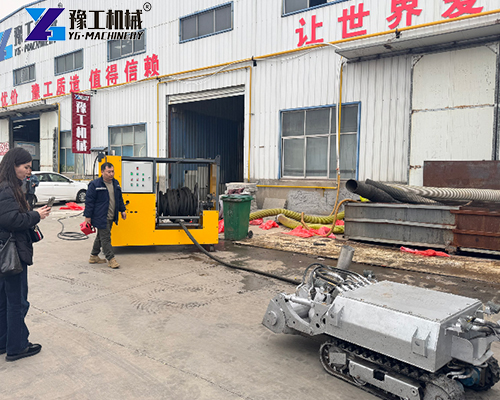
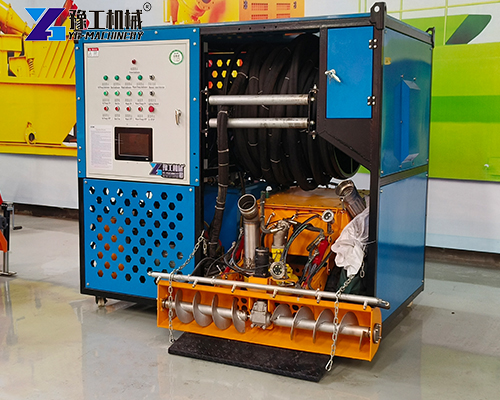
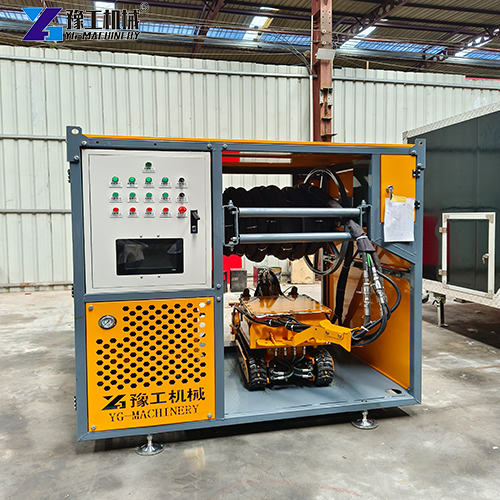
YG recommended the YG800 model sludge transport robot for the farm, with a full underwater unit, workstations, and post-treatment equipment, forming a basic integrated “dredging – conveying – treatment” solution:
Full hydraulic power system, built for cold climates: Uses a closed-loop hydraulic circuit design, works in -20°C to 60°C, and runs 24/7 without overheating. In Canada’s winter, the equipment starts up smoothly without long preheating. Compared with traditional electric units, it saves about 80,000 RMB per year per machine in electricity costs.
Underwater visual monitoring for precise work: Equipped with an underwater HD camera that sends back real-time 1080P video. The operator can see the bottom conditions from the shore control room, control the robot’s path and working position, and avoid accidental hits on aeration pipes and drainage outlets.
Modular work unit for high-organic sludge: The hydraulic auger speed is adjustable from 0–200 rpm, paired with a piston slurry pump with a 30-meter head. When encountering compacted feed residue, the auger breaks it up first, then the pump extracts and conveys it. The unit can handle particles up to 40 mm, reducing clogging risks. This modular robot design lets the customer swap work heads based on the sludge conditions in different ponds.
Anti-corrosion materials for longer service life: Key components use anti-corrosion materials, including stainless steel fasteners and coated protection, to withstand long-term corrosion from high-organic sludge in freshwater environments.
Remote control plus post-treatment: The operator controls the robot’s movement and work from the shore via wireless remote. The extracted sludge is piped to a filter press on shore for solid-liquid separation. After dewatering, the sludge volume is reduced by about 50%, making it easier to transport and dispose of.
YG engineers followed the whole process from equipment selection to on-site commissioning, and the system was delivered and put into operation on schedule. This underwater cleaning machine solution met the farm’s timeline.
Customer Feedback
After 4 months of operation, here are the key figures from the YG800 hydraulic dredging robot at the farm:
- Dredging efficiency: Processed about 150–200 m³ of sludge per day, noticeably faster than manual cleaning. Over 4 months, it removed roughly 18,000 m³ of bottom sediment, with an average cleaning depth of about 0.8 meters across the ponds.
- Labor costs: Previously required 10–12 workers to drain and enter the ponds; now only 2 operators are needed (one remote controller and one on-site helper). Labor costs dropped significantly.
- Safety: No one entered the water during the entire operation, and there were no safety incidents. The equipment worked normally even during the frozen period, avoiding the risks of working on ice.
- Environmental compliance: After solid-liquid separation, clean water returned to the ponds. Water quality gradually recovered after dredging. The dewatered sludge passed testing and was used to improve soil on nearby farmland.
- Equipment stability: Over the 4 months, the equipment ran smoothly. The hydraulic system performed well in low temperatures, and the anti-corrosion materials provided the expected protection.
Customer comment: “We used to drain the ponds every year for cleaning. After using YG’s sludge transport robot, we don’t need to drain the water – the machine just goes across the bottom and sucks up the sludge. Even when it’s minus ten-something degrees in winter, the equipment works fine. It’s faster than manual cleaning, the bottoms are cleaner, and the fish health has definitely improved.”
Speak with Our Product Manager
What Conditions Are Suitable for the Sludge Transport Robot?
The underwater cleaning machine works well in many underwater cleaning scenarios:
- Aquaculture ponds: Including fish ponds, shrimp ponds, and shellfish ponds, for cleaning feed residue and waste buildup.
- Landscape lakes and artificial lakes: Removing nutrient-rich sediment to improve water clarity and reduce odors.
- Industrial settling ponds and storage basins: Cleaning sediment and sludge from production processes.
- Municipal drainage facilities: Including pump station collection basins and treatment plant settling tanks, especially in confined spaces.
The equipment is particularly useful for closed or semi-closed water bodies where workers cannot enter and traditional equipment cannot reach.
How to Choose the Right Sludge Transport Robot Model?
YG offers six models from YG500 to YG1200. When selecting, consider these factors:
- Pond or water area: For small ponds (under 1 hectare), consider YG500 or YG600 with 500-600 mm cleaning width; for medium ponds (1-5 hectares), YG700 or YG800 with 700-800 mm width; for large ponds (over 5 hectares), YG900 or YG1200 with 900-1200 mm width.
- Sludge type and particle size: For soft mud and fine sediment, standard configuration works. For sludge with gravel or compacted material, consider the heavy-duty breaker head, which can handle hard objects up to 40-60 mm.
- Operating depth: Standard equipment can work at depths of 30-90 meters (up to 20 meters underwater), which covers most pond and lake conditions.
- Special environmental needs: For cold areas, consider a diesel power station for easier cold starts; for corrosive water, upgrade the anti-corrosion coating; for tight spaces, choose the more compact YG500.
YG offers technical support from site assessment and equipment selection to on-site commissioning. The 1-year warranty robot provides added peace of mind for customers.
Contact YG
Whether you are a fish farm owner, an environmental engineering company, or a municipal authority, YG can provide tailored dredging solutions and equipment recommendations. The equipment supports custom options, including underwater cameras, electric or diesel displays, high-pressure flush pumps, breaker heads (standard or heavy-duty), full-machine explosion-proof systems, diesel power stations, and wireless remote controls. For detailed pricing and technical solutions, feel free to contact YG.