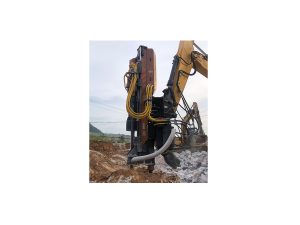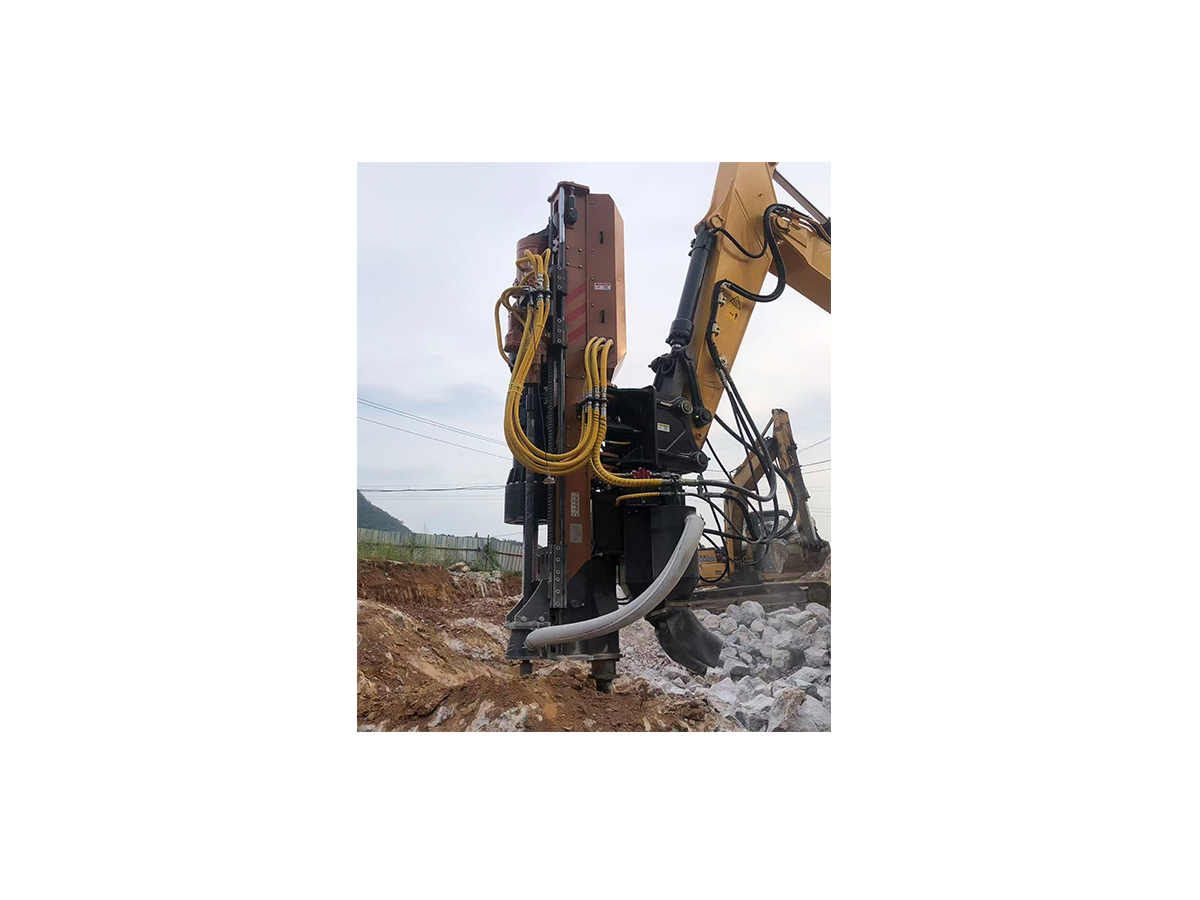

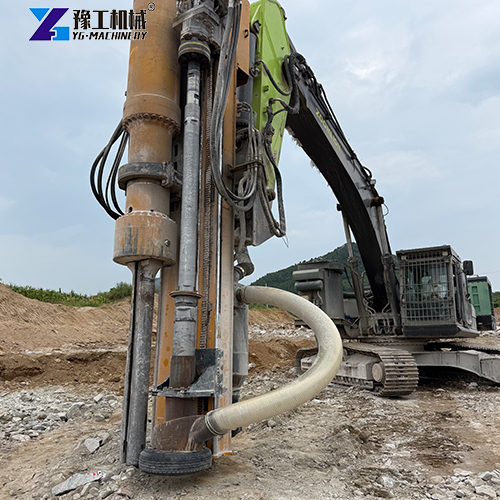
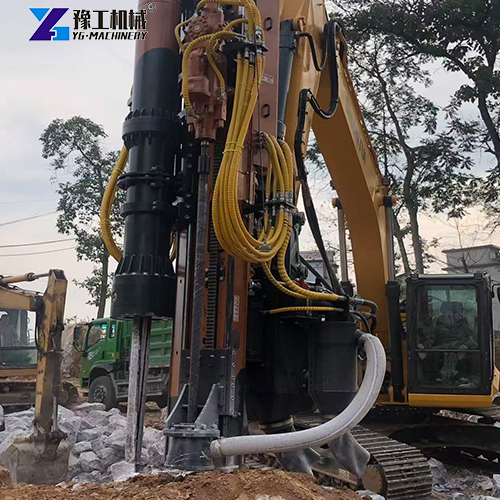
In hard-rock excavation, foundation pit construction, tunnel boring, mining, and municipal engineering, how to break rock efficiently without blasting has long been a concern for construction contractors. Excavator rock drill and splitter integrates rock drilling and hydraulic splitting into one excavator attachment. A single excavator can complete continuous operations including positioning, drilling, splitting, and relocation. It is a static rock-breaking solution for hard and ultra-hard rock.
Integrated Drill & Splitter for Excavator Parameters
YG-152
Applicable Excavator Weight: 36T-48T
| Parameter Name | Unit | Value |
| Piling Beam Length | mm | 4850 |
| Drilling Advance Stroke | mm | 2600 |
| Max Drilling Thrust Force | KN | 50 |
| Max Drilling Pull Force | KN | 32 |
| Piling Advance Stroke | mm | 1800 |
| Max Piling Thrust Force | KN | 160 |
| Max Piling Pull Force | KN | 100 |
| Hydraulic Pressure (Max) | MPa | 35 |
| Hydraulic Flow | L/min | 240 |
| Weight | kg | 6200 |
| Dimensions | mm | 5270×1485×1840 |
| Operation Mode | — | Remote Control |
What is an Excavator Rock Drill and Splitter?
An excavator rock drill and splitter is an integrated drill-and-split attachment mounted on an excavator. Using the excavator as the mobile platform and hydraulic power source, it is equipped with a rock-drilling unit, hydraulic splitting unit, piling beam, hydraulic control system, and auxiliary dust-removal system on the front end.
Its basic working procedure is as follows:
- The excavator moves the integrated rock drill and splitter to the target rock surface, and adjusts the working angle to vertical, inclined, horizontal, or inverted according to construction requirements.
- The rock-drilling system drills holes to the preset diameter and depth in the rock.
- The splitting unit enters the drilled hole, and high-pressure splitting force is applied via the hydraulic system.
- Cracks are generated inside the rock, and controlled fracture is achieved along the designed direction.
- The excavator moves to the next working point for continuous drill-and-split construction.
This method does not rely on explosive impact. Instead, it breaks rock by internal static splitting force after drilling. Therefore, it is especially suitable for areas near residential districts, subway projects, around precision equipment, confined foundation pits, mine slopes, and sites where blasting is prohibited. Industry data shows that drill-and-split equipment applies controlled hydraulic pressure inside drilled holes to create controllable cracks in hard rock or concrete. Its working principle is different from hydraulic breakers that rely on continuous impact.
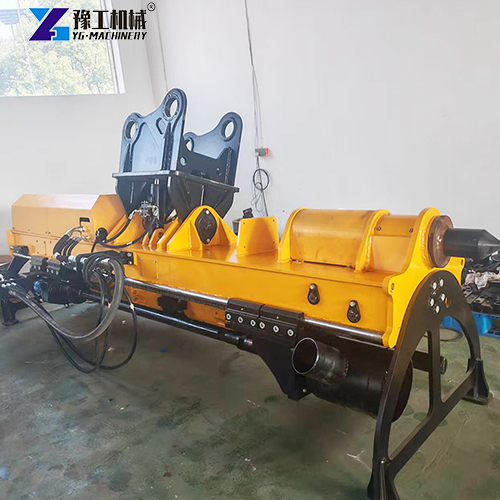
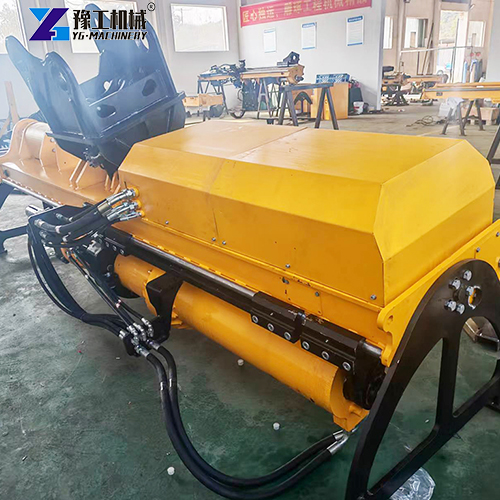
Why Choose Excavator Rock Drill and Splitter?
Compared with hydraulic breakers
Hydraulic breakers break rock by high-frequency impact, suitable for general rock, concrete demolition, and partial crushing work. However, for ultra-hard rock, thick rock strata, or scenarios requiring controlled crack direction, breakers may suffer reduced efficiency, high noise, obvious vibration, and rapid wear of chisels.
Advantages of integrated rock drill and splitter:
- Drill first and split from inside, ideal for high-hardness rock.
- Relatively lower impact and vibration during operation.
- Rock cracking can be controlled via hole positions and splitting direction.
- No frequent switching between drilling rig, splitter, and excavator.
- Under suitable hard-rock working conditions, the working efficiency of the YG drill-and-split machine can reach about 4 times that of traditional breakers.
It should be noted that efficiency improvement is based on actual rock properties and construction plans. For rocks with well-developed fractures, moderate strength or small volume, breakers may still be a cost-effective choice. For projects with ultra-hard rock, blasting-forbidden zones, low-vibration requirements, or precise crack-direction control, the drill-and-split machine delivers more prominent advantages.
Compared with a separate drilling rig plus splitter
When using a combination of independent drilling rig and splitter, drilling must be finished first before the splitter is moved or lifted into the hole. This setup requires more equipment and places higher demands on site space, manpower, and construction organization. Especially in tunnels, foundation pit bottoms, and narrow working faces, equipment relocation and repeated positioning consume plenty of time.
Advantages of Integrated drill & splitter for excavator:
- Drilling and splitting are integrated in one attachment to reduce equipment quantity.
- The excavator provides mobility, positioning, and hydraulic power for better maneuverability.
- Saves waiting time for splitter setup after drilling.
- Main procedures can be completed by one operator via remote control and excavator operation.
- Improves construction continuity in narrow spaces, multi-angle, and complex cross-section sites.
Compared with blasting construction
Blasting is suitable for large-scale rock excavation, yet brings issues including approval procedures, safety alerts, vibration, flying rocks, noise, dust, and protection of surrounding structures. In urban construction, plant renovation, subway projects, areas near residential buildings and sensitive facilities, blasting is often impractical or subject to strict restrictions.
Advantages of excavator mounted drilling and splitting machine:
- No explosives or detonation work, reducing blasting formalities and alert management.
- Enables fine, hole-by-hole and section-by-section directional rock fracture.
- Perfect for construction sites close to buildings, roads, underground pipelines, and precision equipment.
- Flexible movement and positioning within limited working surfaces.
- Helps reduce impacts on nearby personnel and the environment.
Speak with Our Product Manager
7 Advantages of YG Excavator Rock Drill and Splitter
YG integrated rock drill and splitter integrates rock drilling, splitting, and excavator-attachment-style operation. It is designed for hard rock, ultra-hard rock, foundation pit, slope, tunnel, and complex cross-section excavation. With stable drilling, powerful splitting, and multi-angle positioning, it helps construction teams improve rock-breaking efficiency and construction controllability without blasting.
- Imported splitting blocks for complex rock surfaces: Made of high-strength imported splitting-block material with superior wear resistance and load-bearing capacity. It can handle foundation pit corners, sloped rock faces, irregular cross-sections, and multi-angle construction.
- Swedish rock-drilling technology & patented drill frame: The rock-drilling system adopts Swedish rock-drilling technology matched with a patented drill-frame structure. The compact and stable structure delivers accurate hole positioning, reduces drilling deviation, and extends the service life of core components.
- Italian hydraulic boosting system: Equipped with a high-efficiency hydraulic boosting system. While keeping a lightweight design, it provides stable hydraulic output and sustained splitting capacity for continuous hard-rock mining.
- Wireless remote control for safer operation: Supports standalone wireless remote-control operation. Operators can control drilling and splitting from a relatively safe area, reducing exposure to slopes, rock faces, deep foundation pits, and falling-rock risk zones.
- Multi-angle drilling & splitting for strong adaptability: Leveraging the excavator’s boom and arm, it can perform vertical, inclined, horizontal, and inverted drilling and splitting. Suitable for steep slopes, high slopes, foundation pits, tunnels, and complex rock faces.
- Two-stage cylinders with synchronous boosting for stronger splitting force: Adopts a synchronous pressure-boosting design for two-stage splitting cylinders to achieve a double-boosting effect. It generates stronger internal splitting force for intact hard and ultra-hard rock, improving rock-breaking efficiency and single-cycle output.
- Efficient static rock-breaking solution: The equipment cracks rock from inside through a “drill-first-then-split” procedure without blasting. Ideal for engineering environments with strict requirements on vibration, noise, safety, and construction precision.
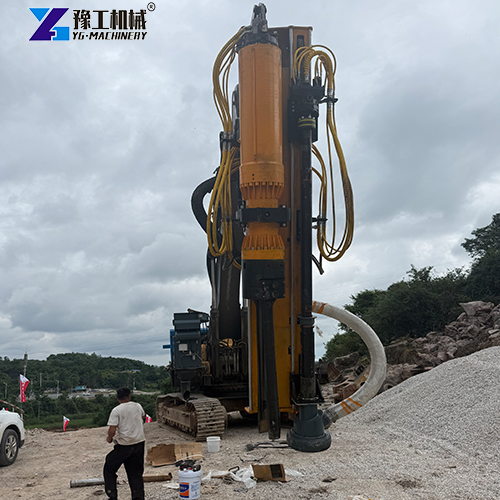
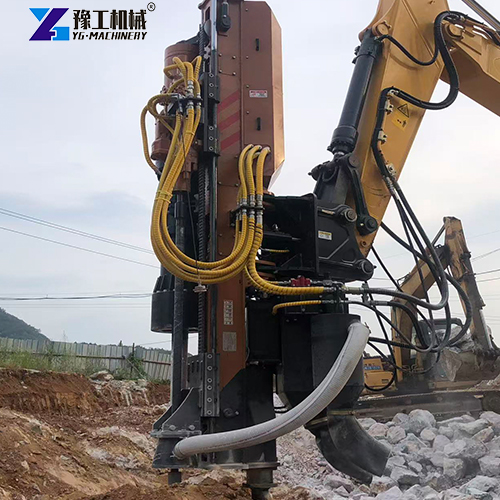
Speak with Our Product Manager
How to Select a Suitable Integrated Rock Drill and Splitter?
When selecting an excavator rock drill and splitter, comprehensive evaluation should cover four aspects: rock conditions, excavator specifications, construction objectives, and site constraints, instead of only focusing on equipment weight or drilling depth.
Key points to confirm:
- Rock type, compressive strength, integrity, joints and fissures, weathering degree.
- Rock thickness, excavation volume, and target construction cycle.
- Existence of free faces and whether free faces need to be created by hole layout.
- Excavator tonnage, hydraulic flow, system pressure, stability, and attachment mounting conditions.
- Requirements for vertical, inclined, horizontal, inverted, or high-reach arm operation.
- Site restrictions on blasting, vibration, noise and dust.
- Whether the project is in tunnels, deep foundation pits, underground works, slopes, or densely populated areas.
- Need for a screw air compressor, slag-blowing device and high-efficiency dust-removal system.
- Requirement for wireless remote control to improve operational safety near high-risk rock faces.
- Project requirement for continuous operation, as well as demands for spare parts, maintenance, and after-sales service response.
For example, for projects with 36-48-ton excavators, thick hard rock, and deep-hole drill-and-split demands, YG-152 is a key model for evaluation. For sites with limited space, lower-tonnage excavators, or mainly partial hard-rock treatment, lightweight excavator rock drill and splitter adaptable to 20-ton-class and above excavators can be considered.
YG Excavator Mounted Drilling and Splitting Machine for Sale
YG integrated drill & splitter for excavator supports configuration matching according to working conditions, such as wireless remote-control system, rock-drilling drill frame, hydraulic boosting system, two-stage splitting cylinders, dust-removal & slag-discharge system, and drill-and-split tools of different specifications. For medium-to-large hard-rock projects, YG-152 fits 36-48-ton excavators. For space-limited projects or those with smaller-tonnage excavators, lightweight models can be evaluated; some units can be adapted to excavators of around 20-ton class.
When making an inquiry, please provide the excavator model, hydraulic parameters, rock photos or geological survey data, construction-site dimensions and estimated engineering quantity. This helps verify attachment compatibility, working solution, and equipment configuration.