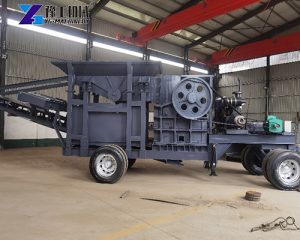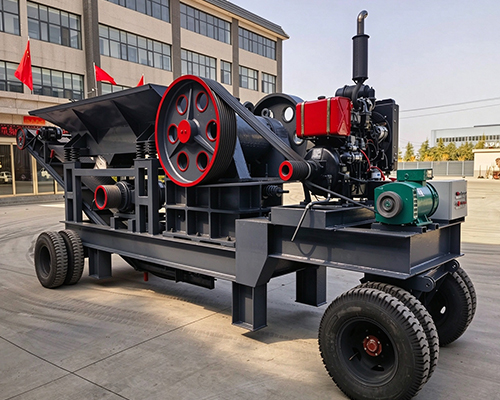

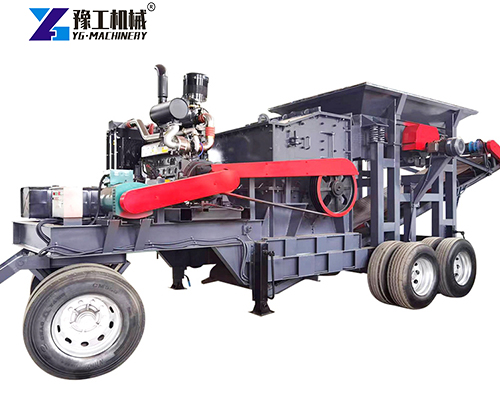
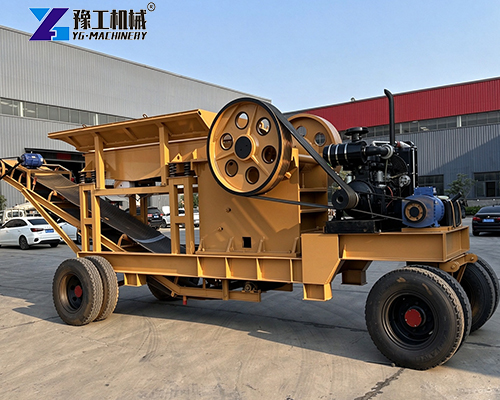
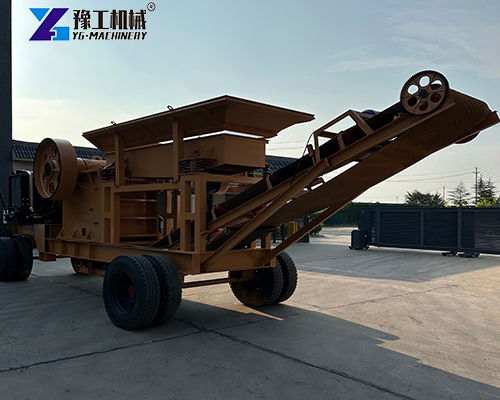
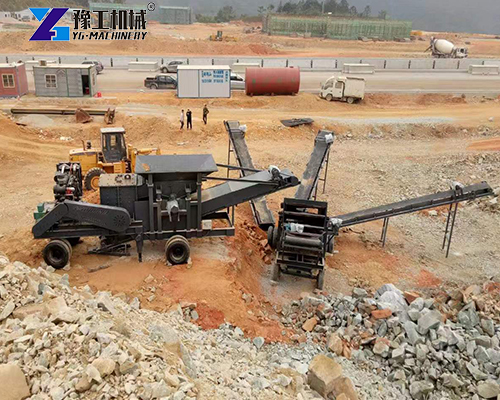
From quarry aggregate production and mining operations to highway construction and construction waste recycling, a mobile crushing machine can crush materials directly on-site where the raw materials are generated. The machine works well for iron ore, granite, quartz stone, limestone, pebbles, and basalt. By cutting long-distance transport of raw materials, it helps contractors lower hauling costs, gain greater construction flexibility, and speed up project startup.
Mobile Stone Crushing Machine Parameters
| Model | Feeder Opening Size(mm) | Max. Feeding Size (mm) | Outlet adjusting Size(mm) | Capacity (t/h) | Motor Power (kW) | Overall Dimension (mm) |
| YG250x400 | 250×400 | 210 | 25-60 | 5-20 | 15 | 1215x1240x1210 |
| YG400x600 | 400×600 | 350 | 40-90 | 15-60 | 30 | 1700x1750x1680 |
| YG500x750 | 500×750 | 425 | 50-100 | 40-130 | 45 | 2150x1900x1950 |
| YG600x900 | 600×900 | 500 | 60-125 | 90-180 | 55 | 2500x2010x2350 |
| YG750x1060 | 750×1060 | 630 | 60-150 | 110-380 | 110 | 2630x2310x3110 |
| YG900x1200 | 900×1200 | 750 | 95-165 | 220-450 | 132 | 3720x2850x3250 |
| YG1000x1200 | 1000×1200 | 850 | 200-300 | 280-560 | 160 | 3820x2850x3250 |
| YG1200x1500 | 1200×1500 | 1020 | 150-300 | 400-800 | 220 | 4590x3342x3553 |
| YG1500x1800 | 1500×1800 | 1200 | 210-360 | 520-1100 | 280 | 5100x4700x4300 |
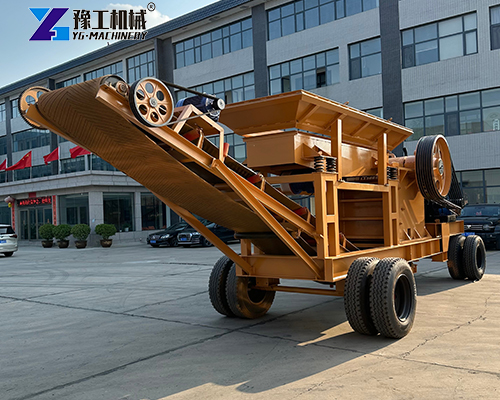
Structure: Fixed jaw plate, movable jaw plate, main frame, upper and lower guard plates, adjustment seat, movable jaw tension rod. It adopts a welded frame structure for high strength and reliability. The optimized structure is lightweight and compact, space-saving, and easy to install and transport.
Working Principle: The motor drives the pulley to rotate the eccentric shaft. The movable jaw moves toward and away from the fixed jaw repeatedly. Materials inside the crushing chamber get squeezed, rubbed, and ground to reduce large rocks into smaller particles. Discharging happens once the material size meets the requirement.
Features: Deep crushing chamber without dead zones, improving feeding capacity and output; large crushing ratio; uniform finished grain size; special flywheel design reduces vibration for smoother operation; gap adjustment by shims for simple operation; low running cost and easy maintenance.
In-Stock Models Ready to Ship – See What’s Available
Benefits of Using Mobile Crushing Machine
Its biggest advantage is simple: bring the crusher to your material. Crushing can move forward to mining faces, quarries, or demolition sites to reduce repeated handling and long-distance hauling.
- Lower transport cost: On-site crushing shortens hauling distance and cuts fuel, vehicle, and labor expenses.
- Fast commissioning: No heavy concrete foundation or large civil works needed, shortening installation and startup time.
- Flexible relocation: The unit can move as mining faces advance or projects shift, ideal for multiple job sites.
- Space-saving: Compact footprint, suitable for narrow or limited working areas.
- Lower operating cost: Fewer material handling steps, helping many projects cut overall operation expenses.
- Better environmental performance: Fewer delivery trucks and less re-handling mean less dust, noise, and carbon emissions.
- Wide application range: Works for hard rock crushing, aggregate production, construction waste recycling, and more.
Materials & Applications for Mobile Crushing Machine
Materials processable by YG series:
- Iron ore
- Granite
- Quartz stone, limestone
- Pebbles
- Basalt
Applications by industry
| Industry | Typical Uses |
| Construction & Demolition | Crush concrete and masonry waste to produce reusable aggregates |
| Quarry & Aggregate | Primary or secondary crushing at the working face |
| Road & Highway | Produce subbase and base materials right at the material point |
| Mining | Crush ore in pits to reduce mine truck haulage |
| Recycling | Turn construction waste into qualified aggregates |
| River & Riverbed | Process river pebbles and stones on site |
| Remote Sites | Locations with long haul distance, difficult access or impractical fixed crushing plants |
Mobile Stone Crusher Investment & ROI Analysis
Mobile stone crusher price is only half the story. The other half is what returns this machine can bring. Below is a practical evaluation framework you can follow.
Cost Side — Items to consider
- Machine cost. Total purchase price depends on model and capacity. The series covers a wide range from 15 kW / 5–20 t/h up to 280 kW / 520–1,100 t/h.
- Configuration cost. Chassis type, feed and discharge conveyors, control system, and electrical standards matching your local market.
- Wear parts — Ongoing expense. Jaw plates and guard plates are consumables. Cost per ton relies on material abrasiveness and wear part quality.
- Fuel or electricity. Motor power ranges from 15 kW to 280 kW. Energy consumption per hour rises with larger models, but output also increases. The key metric is cost per ton, not hourly power use.
- Labor. Crew size depends on configuration and automation. On-site crushing normally needs fewer material handlers than the “fixed plant + hauling” setup.
- Maintenance & downtime. Scheduled inspection and wear part replacement. Downtime cost should be calculated based on hourly production value, not just repair fees.
- Relocation & logistics. Transport cost counts if you move the machine. Overall dimensions from about 1.2 m to over 5 m directly affect shipping plans and charges.
Return Side — Items to calculate
- Saved transport cost. The main source of return. Calculate the cost per ton to haul raw material to a fixed plant and haul finished aggregates out — this is your baseline for comparison.
- Saved disposal cost (for recycling projects). Compare landfill tipping fees plus haul-out cost against the value of recycled aggregates.
- Material value created. Crushed aggregates, road base, and sized stones have market value. On-site crushing captures the price gap between raw rock and finished products.
- Extra production hours. Faster setup and no transport bottlenecks mean more effective production hours within the same contract period.
- Residual asset value. Mobile crushers hold transferable value; fixed plants are tied to one location.
Sample Calculation — Template
Figures below are for illustration only. Replace them with your local real data. Assume a project needs 50,000 tons of crushed output within 12 months.
| Item | Calculation | Sample Figure |
| Saved hauling to fixed plant | 50,000 t × transport cost per ton | Fill with local haul rate |
| Saved disposal fee (if recycling) | 50,000 t × landfill tipping fee per ton | Fill with local landfill rate |
| Value of finished aggregates | 50,000 t × local aggregate price | Fill with local market price |
| Less: Wear parts | 50,000 t × wear cost per ton | Fill by material abrasiveness |
| Less: Energy | Working hours × power/fuel rate | Fill with local energy rate |
| Less: Labor | Crew size × hours × labor rate | Fill with local labor cost |
| Less: Maintenance reserve | Annual percentage of machine cost | Fill based on service records |
| Net benefit | Total return minus total cost | Compare against machine cost |
How to read the result: Divide total machine cost by annual net benefit to get simple payback period. If your project duration is shorter than the payback time, residual value becomes critical. This is exactly the advantage of buying a mobile stone crusher for sale over fixed crushing installations.
How to Pick the Right Mobile Crushing Machine?
When selecting a mobile stone crusher for sale, evaluate material type, output demand, finished size requirement, site condition, and budget together. An undersized unit creates capacity bottlenecks; an oversized one brings unnecessary purchase and energy costs.
1. Confirm material hardness and maximum feed size
Check raw material type and maximum block size first. For example, if the largest rock is around 500 mm, YG600x900 with 500 mm max feed size is a good option. For hard materials such as granite, basalt, quartz stone, and iron ore, pay close attention to crushing chamber design and wear part quality.
2. Match model to required output
Choose according to the hourly finished output required for the project, not just the cheapest model.
| Project Scale | Recommended Capacity | Suggested Models |
| Small works, trial projects | 5-60 t/h | YG250x400, YG400x600 |
| Medium quarry, highway projects | 40-180 t/h | YG500x750, YG600x900 |
| Medium-large aggregate lines | 110-560 t/h | YG750x1060, YG900x1200, YG1000x1200 |
| Large mines, high-output quarries | 400-1100 t/h | YG1200x1500, YG1500x1800 |
3. Clarify finished particle size requirement
Different projects require different aggregate sizes. This machine uses shim adjustment for the discharge opening, so the output size can be adjusted within the model range. For reference, YG500x750 adjusts discharge from 50-100 mm with a capacity of 40-130 t/h.
4. Assess relocation frequency and site conditions
Take road access, working space, ground bearing capacity, power supply, and relocation frequency into account. Welded frame and compact layout work best for tight sites and frequent moves.
5. Check after-sales support and spare parts supply
Wear part lead time, technical support, warranty terms, and on-site service capability matter a lot.
FAQ about Mobile Crushing Machine
Q: What is the difference between a mobile crushing machine and a fixed crushing line?
mobile stone crushing machine requires no civil construction, starts fast, and moves easily, suitable for short-term scattered jobs. Fixed plants deliver higher steady output for permanent large mine operations.
Q: What maintenance work is needed?
Inspect jaw plates and guard plates regularly, check discharge gap setting, and examine transmission parts. The design offers easy access for inspection and maintenance, and shim adjustment is simple on site.
Q: How many workers are needed to run one mobile stone crushing machine?
Standard setup: 1 operator plus 1 maintenance inspector. High automation versions can run with one person only.
Q: How to level a wheeled mobile stone crushing machine?
Use wooden blocks or jacks at the four corners for leveling. Keep the level error within reasonable limits to prevent drifting and excessive vibration.